
Can you imagine being able to help other people no matter where you are? That possibility, which just a few years ago seemed reserved for very specific cases, today is part of a new way of understanding solidarity.
The COVID-19 pandemic marked a turning point in virtually every area of our daily lives. Paradoxically, it was one of the moments when help was most needed and, at the same time, one of the most difficult in which to provide it. At that time, volunteering found in the digital environment a stable way to act, making it possible to connect those willing to contribute with those in need of support.
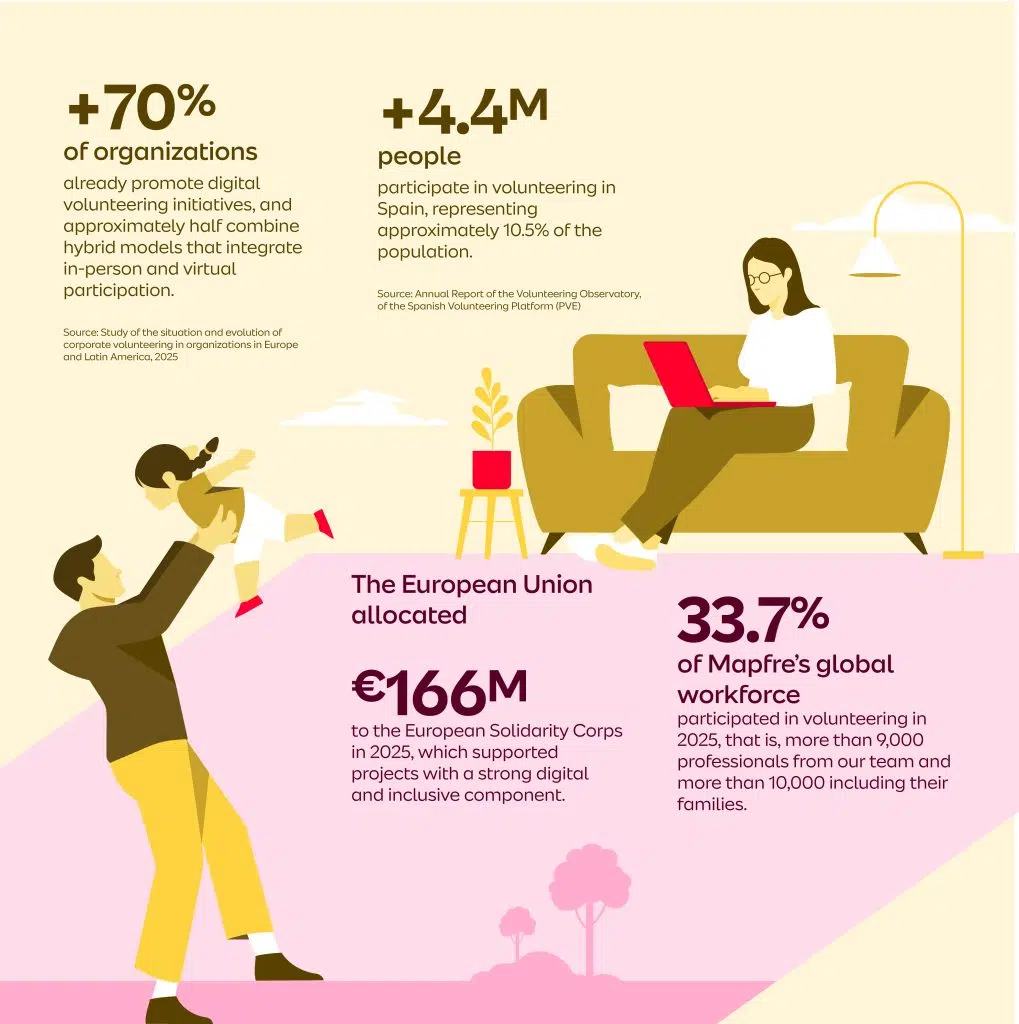
Online volunteering complements in-person volunteering, making it more flexible, more accessible, and, in many cases, more consistent. Thus, new opportunities have opened up to get involved in causes that were previously far away, both in distance and in time. In Europe, more than 70% of organizations are already promoting digital volunteering initiatives, and approximately half combine hybrid models that integrate in-person and virtual activities, a figure that shows the structural change in the way we collaborate.
Solidarity that adapts to real life
Some volunteers accompany older people via video calls to help combat loneliness. Others tutor secondary school students or share tips and guidance on how to find their first job. There are also technical profiles who contribute to projects in web development, translation, or data analysis. Each person can find a way to contribute that matches their skills and availability.
Given that time is a very limited resource for many people, online volunteering makes participation more flexible: some contribute several hours a week, others only on weekends, and some take part in one-off projects. In any case, the digitalization of solidarity is acting as a gateway to social engagement that would otherwise not be possible. Thanks to citizens’ involvement and the accessibility of the digital environment, volunteering has become an established social practice. Although there are no precise figures on remote volunteering, it is estimated that in Spain alone more than 4.4 million people take part in volunteering activities of some kind, representing around 10.5% of the population.
Volunteering transforms those who receive it, but also those who do it. Various studies by international organizations, such as the United Nations and the European Commission, highlight that volunteering contributes to emotional well-being, strengthens a sense of purpose, and enhances social and professional skills. In a digital environment, these benefits may even be amplified, as interaction with different realities—often in other countries or cultural contexts—enriches the experience and fosters a more diverse perspective. At the same time, those receiving support gain access to resources that, in many cases, would not be available locally. For these reasons, the European Union allocated 166 million euros to the European Solidarity Corps in 2025, which supported projects with a strong digital and inclusive component.
The role of companies in the transformation of volunteering
More and more organizations, both public and private, integrate volunteering into their social strategy as part of their way of interacting with society. In this way, online volunteering is enabling the participation of workforces distributed around the world and allowing solidarity initiatives to scale more quickly.
At Mapfre, we understand volunteering as an essential form of engagement with society. Driven by this conviction, we promote different channels to facilitate the social participation of our professionals and their families, including in digital environments. Our corporate volunteering program, managed through Fundación Mapfre, is present in 26 countries and includes initiatives related to health, education, nutrition, and the environment. Through this program we seek to improve the well-being of the most vulnerable communities and contribute to a more supportive environment. This approach, apart from the external impact, reinforces our internal culture by promoting skills such as empathy, leadership, or teamwork. Additionally, we have professionalized volunteer management to ensure the quality and continuity of these initiatives. We have a Corporate Volunteering Committee that ensures the consistency of actions with our global People, Organization, and Sustainability strategy, as well as with the 2030 Agenda. Today, we are the only IBEX 35 company in Spain with ISO 9001 certification from AENOR in corporate volunteering management.
The real impact of Mapfre
In 2025, 33.7% of Mapfre’s global workforce participated in volunteering activities, i.e., more than 9,000 professionals from our team and more than 10,000 including their family members. In one year, more than 2,452 activities were carried out, equivalent to almost seven initiatives per day worldwide. In total, more than 55,000 hours of volunteering were dedicated, directly benefiting over 170,000 people in vulnerable situations. These figures reflect a real, sustained level of engagement that continues to grow. Our volunteering also contributes to 15 of the 17 Sustainable Development Goals (SDGs), reinforcing its role within a cross-cutting sustainability strategy.
However, there is still room for improvement. The digital divide, for example, remains a challenge in many regions around the world. It is also about ensuring that technology is used inclusively. Fortunately, there are more and more projects that put technology at the service of people, so that screens shorten distances between those who participate in solidarity activities. At Mapfre, we will continue working to promote new ways to boost this participation.