
Since the beginning of the 21st century, we have gone from asking whether it was possible to travel without polluting to demanding that it be so. After several decades of climate education, we now understand that the mobility of our time is a reflection of a more digital, more aware, and more demanding world regarding the footprint it leaves behind. We are in the midst of a search for the perfect combination of progress and respect for the environment, and for that reason, it has been essential to rethink the way we move.
Sustainable mobility is today a priority in the international agenda. This is observed, for example, in the consumption habits of citizens. Globally, around a quarter of all cars sold are electric. In this market, China leads the globe; in 2024, it sold 11 million electric cars, which is more than all the other countries in the world combined.
Europe is also making progress, particularly thanks to record funding for innovation in mobility.Between 2021 and 2025, the EU allocated nearly €430 million from the Horizon Europe program for research in sustainable urban mobility. These resources cover everything from urban planning and logistics to traffic management and road safety, demonstrating a commitment to making cities cleaner. Under this situation, countries like Norway cement their global leadership in electrification of transportation. In this country, nearly 96% of the new cars registered in 2025 were electric, a jump from the 89% reached in 2024. In December 2025, Norwegian electric vehicle registrations approached 98%, meaning they practically eliminated all combustion vehicles from dealerships. This is an exceptional case, as the European Union as a whole stands at around 21% electric share; however, countries such as Sweden, Denmark, and Finland already exceed 50% of electric vehicle sales.
Beyond electrification, the sustainable mobility revolution also goes hand in hand with smart technology. Last year, advances were consolidated in smart transportation systems. For example, several cities have experimented with taxis and autonomous buses in controlled environments, anticipating a future in which driverless vehicles will reduce accidents and optimize traffic. Likewise, progress in artificial intelligence (AI) and sensors is allowing cars to “read” their environment and make decisions in real time. There are already pilot projects in Europe deploying sustainable automated vehicle fleets for on-demand public transport. That said, the massive adoption of autonomous vehicles still faces numerous challenges (legislative, technical, and public confidence). Where AI is already making an impact is in efficient traffic management. There are cities that are adopting adaptive traffic lights and data analysis systems to reduce traffic congestion and emissions. We witnessed a remarkable example during the Paris 2024 Olympic Games, when an AI-driven management system managed to improve shuttle bus speeds by up to 20% and reduce wait times at key intersections by nearly 19%.
Technological momentum often goes hand in hand with public policies aimed at steering the transition towards clean transportation. An example from Spain is the Sustainable Mobility Act, which came into effect in December 2025. This regulation sets out a strategic framework to decarbonize transport and modernize mobility nationwide, and, for the first time, enshrines mobility as a fundamental right—accessible, sustainable and safe for all. This law, among other lines of action, requires companies with more than 200 employees to adopt sustainable mobility plans for their workers within two years. Another measure is the limitation on short-distance domestic flights, as domestic travel routes for which there is a railway alternative of less than 2.5 hours are prohibited. Although ambitious, this law provides a general framework that still does not establish either deadlines or detailed funding for many measures, raising some questions about its effective implementation.
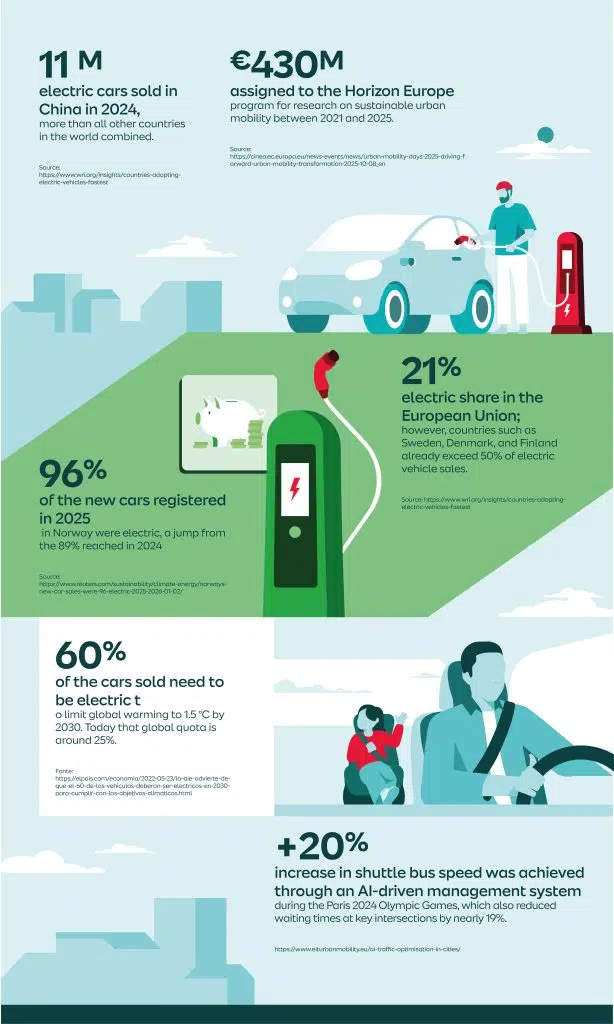
So, with the achievements and changes of recent years, what can we expect to shape the sustainable mobility agenda in 2026? First of all, an acceleration in the electrification of transport. Some experts point out that, to limit global warming to 1.5 °C by 2030, 60% of the cars sold need to be electric.Today, that global share is around 25%, so the coming years will be critical for scaling electric vehicle production, reducing the cost of batteries, and deploying a wide and reliable recharging infrastructure. In 2026, we will surely see more fast charging points on roads and in cities, as well as perhaps the first serious steps towards the electrification of heavy transport (trucks and long-distance buses), a segment that is starting to take off.
In this context, we at Mapfre reaffirm our corporate commitment to sustainable mobility. In 2025, we exceeded the carbon footprint cut targets that we had set for this year. In data, we have managed to reduce our global footprint by more than 24% compared to 2022, while the target was set at 21%. This decline has been achieved thanks to a wide range of measures, from restricting the use of fossil fuels and improving energy efficiency to the adoption of renewable energy sources and the transition of corporate fleets toward hybrid and electric vehicles. This confirms progress toward the targets defined for the year under the Environmental Footprint Plan. At the same time, at Mapfre we have generated, just in the last year, a total of 3.47 GWh of renewable energy through photovoltaic installations in several of our buildings. This energy is intended for self-consumption, and as a result, greenhouse gas emissions were reduced by 791 tCO2e. Looking to the future, we have launched a strategic project to ensure that 100% of the electricity consumed by the Group comes from renewable sources in all countries where we operate by 2030. After all, our overall goal is to achieve Net Zero by 2050.
Ultimately, last year has helped to lay the foundations for a future with more environmentally friendly transport. There are significant challenges remaining, from accelerating the adoption of electric vehicles to ensuring that ambitious policies translate into effective action, but the course is set. Thus, if we continue taking steps forward, our ways of moving will be able to accompany the change that the planet demands from us.