
Spain is aging at an accelerated pace, but its labor market continues to look the other way. While 31% of unemployed people over 55 have been looking for work for more than a year, science shows that cognitive performance reaches its highest point between 55 and 60 years old. Experience does not expire: it is wasted.
Age as an invisible barrier
For decades, society has been redefining what it means to grow older. The 30s have become the new 20s, then the 40s, and later the 50s. We live longer, work for longer periods, and reach maturity with more tools than any previous generation. However, in many companies, aging remains a silent problem.
That phenomenon has a name: ageism. In practice, it translates into resumes that stop receiving answers, into meetings where experience weighs less than enthusiasm, or into corporate cultures that confuse youth with agility. It is such a widespread bias that, at times, it is not even perceived as such.
A country that ages without integrating its own talent
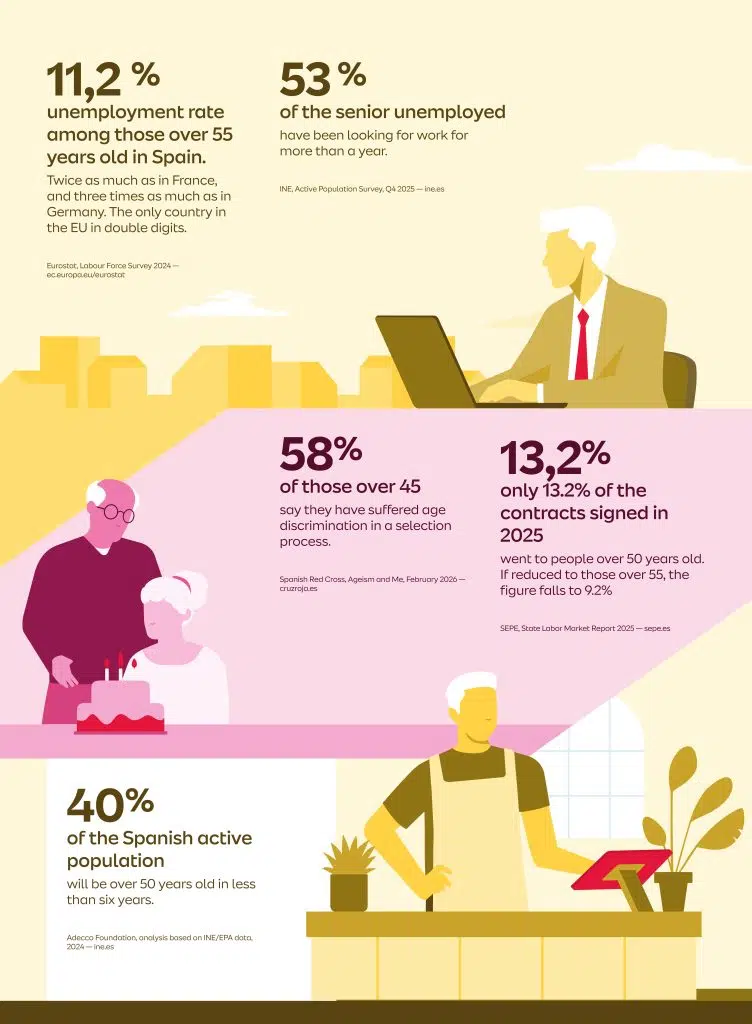
Spain faces an unavoidable demographic challenge. More than 15.5 million people are between 55 and 75 years old, which represents 32% of the population. And in less than six years, 40% of the workforce will be over 50. It is not a question of social responsibility: it is a structural necessity.
Despite this, the unemployment rate among those over 55 years old sits at 11.2%, double that of France and triple that of Germany. Spain is the only country in the European Union where senior unemployment exceeds double digits. Of the more than 14 million contracts signed last year, barely 9.2% were for those over 55, and if we expand the range to those over 50, the figure only reaches 13.2%. The system is systematically leaving out a growing part of itself.
The personal impact is equally profound. More than half of the senior unemployed have been looking for work for more than a year, and 58% of those over 45 say they have suffered age discrimination in a selection process. We are not talking about perceptions: we are talking about interrupted careers, lost knowledge, and a labor model that penalizes precisely what it should value.
Science debunks the myth: cognitive capacity matures with age
At the heart of this problem is a scientific misunderstanding. Cognitive psychology distinguishes between two types of intelligence: fluid, which allows solving new problems and adapting to unknown situations, and crystallized, which is based on accumulated knowledge, the interpretation of reality, and judgment forged with experience.
Fluid intelligence reaches its peak in young people and then declines. Crystallized intelligence, on the other hand, not only remains, but continues growing with the years. Research such as that by psychologist Gilles Gignac point to global cognitive performance reaching its maximum between 55 and 60 years of age. In areas such as vocabulary, deep understanding, or judgment, the peak may come even later.
Brain plasticity also persists much longer than is usually assumed. A study published in Nature identified the so-called “superagers,” people over 80 years old with memory comparable to that of someone thirty years younger. Biological evidence confirms that the aging brain remains plastic. History already hinted at it: Cervantes published the second part of Don Quixote at 67, and Borges learned Icelandic in old age in order to read the sagas in their original language.
The economic value of senior talent
The stability of senior talent has a direct economic impact. Their presence reduces turnover, decreases acquisition costs, and prevents the loss of critical knowledge. According to a report by Accenture and Harvard Business School, companies that integrate senior profiles are 36% less likely to suffer talent shortages. In multi-generational teams, their contribution improves cohesion and the quality of decisions. Their role as mentors—vessels of culture, criteria, and organizational memory—is hardly replaceable.
The market has begun to recognize this opportunity. In 2024, investor Katerina Stroponiati launched Brilliant Minds, a venture capital fund focused exclusively on entrepreneurs over 50 years old. More than 500 founders have contacted her since its launch, with a median age of 65 years. First-time entrepreneurs accounted for 64%, and more than a third had experience in sectors such as biotechnology, artificial intelligence, or fintech.
Mapfre’s commitment to senior talent
We are 30,846 people at Mapfre, and we work together with five different generations, from veterans and baby boomers to Generation Z. It is not a coincidence: it is a strategic decision. Those over 50 represent 31% of our global workforce, more than 9,575 professionals. Far from seeing it as a demographic challenge, we treat it as a competitive advantage.
From this vision comes Proyecto Ageing (Project Aging), structured around three fundamental pillars: fostering senior talent, supporting the transition to retirement, and offering flexibility adapted to each vital moment. In practice, this translates into initiatives such as the Generational Zoom, which analyzes HR processes to detect age bias; the Digital Skills program, which trained more than 2,108 employees over the age of 50 last year; and Generational Engagement, which turns the experience of professionals over 55 into a shared asset. Only in 2025, 304 mentors transmitted knowledge to 534 mentees. In addition, we have a Senior Talent Satisfaction Index, with a target of 73% by 2026, which acts as a real barometer of the effectiveness of our policies.
This commitment is not made in isolation. Mapfre has been a signatory since 2016 of the Code of Principles on Generational Diversity of the Generation & Talent Observatory, participates in the Diversity Labs of the SERES Foundation, is part of the EFR group of the Másfamilia Foundation, and of the IE Business School Diversity Lab. We have also sponsored three reports from the IE University Demography Observatory and collaborate with Deusto Business School through the Ageingnomics cycle.
According to the report Senior Career and Talent 2023, Mapfre leads the IBEX 35 ranking in commitment to senior citizens for the third consecutive year. But beyond the recognitions, what defines us is a deep conviction: in a company where five generations coexist, talent has no expiration date.