For years, identity was understood as an aesthetic issue. A well-designed logo, a recognizable typeface, or a coherent chromatic palette. Important elements, no doubt, but often treated as mere packaging or something to be considered once what truly matters has been defined. Today, that view is no longer sufficient, and identity has become one of the main tools for building consistency and credibility. It is no coincidence that many companies meticulously take care of their way they present themselves to the world. As with individuals, appearance communicates even before a single word is spoken. In El vestido habla (The Dress Speaks), sociologist Nicola Squicciarino reminds us that every aesthetic choice is, ultimately, a statement. In the corporate sphere, appearance also communicates from the very first point of contact. Today, aesthetic elements are perceived as clear signals of an organization’s identity, values, and way of engaging with the world.
A strategic pillar
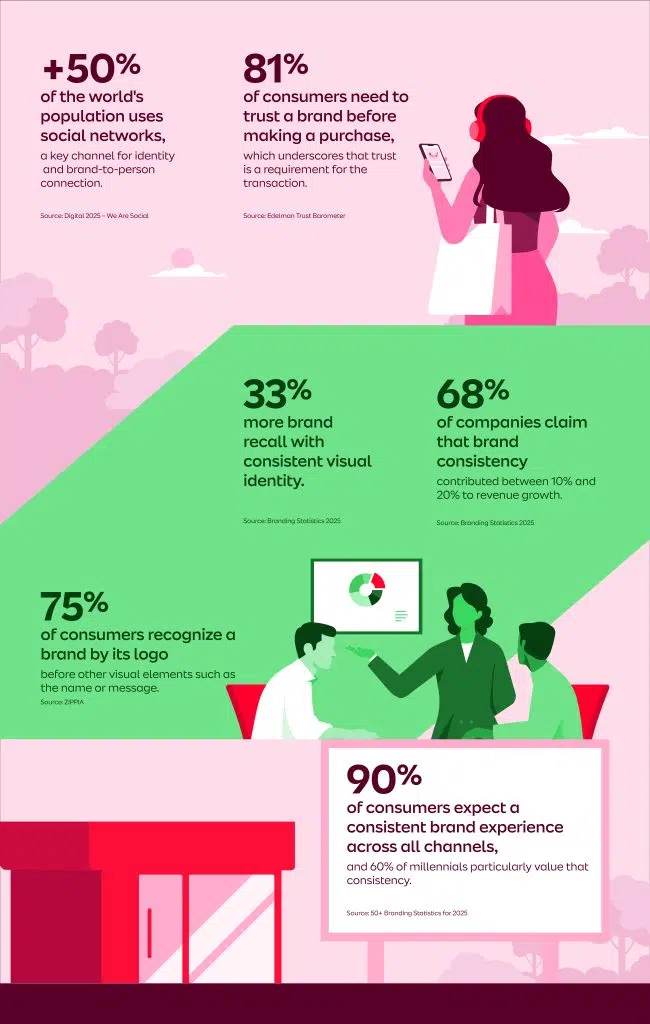
Corporate identity acts as a symbolic contract between the organization and society, with an implicit promise about who it is, what it defends, or how it acts. It is no coincidence that the Edelman Trust Barometer has been emphasizing for years that trust in organizations increasingly depends on the consistency between what they say and what they do. In other words, it is not enough to proclaim values; they must be consistently communicated in all decisions, from strategy to visual communication. Identity permeates internal culture, guides the behavior of teams, and conditions external perception, so although it may seem superficial, it is a first-level strategic decision.
The rise of digital channels has multiplied the touchpoints between brands and people, requiring identity to be conceived as a living system, capable of adapting to multiple formats, screens, and cultural contexts. At a global level, the ecosystem is no longer structured around a single “primary medium,” but rather a fragmented journey: web, app, social media, virtual assistants, and hybrid experiences. According to Digital Report 2026, the latest edition of the annual study conducted by We Are Social, the number of Internet users worldwide reached 6.04 billion people as of October 2025, representing 74% of the global population (8.142 billion). Channels are not only multiplying; connected devices are diversifying as well. The IoT universe continues to expand, and according to IoT Analytics, the number of connected devices is expected to reach 39 billion by 2030. This reinforces the idea that, if identity is to remain coherent, it must work across an increasingly wide range of surfaces and formats—from a screen to audio, or from a wearable to a physical environment—while maintaining the same underlying message about who I am, what I promise, and how I deliver on it.
The universal language of the visual
A coherent brand makes it possible to be recognized and understood across diverse cultural contexts. This is especially relevant for organizations with an international presence. The challenge lies in building an identity that is strong enough to remain consistent, yet flexible enough to adapt to local realities without losing its essence. With this purpose, at Mapfre, we have begun 2026 with a new identity, the result of a deep reflection on who we are as a global group and the role we want to play in society. We are adapting to a more demanding cultural and technological context while connecting more effectively with new audiences. “In 2024, we asked ourselves the most honest question possible: does this brand tell the story of what we truly are today? And the answer was clear: when your brand does not reflect your reality, you have a problem, because people do not see what you are, they see what you project. That gap between what we are and how we are perceived was the real driver behind the rebranding,” states Alfredo García-Almonacid Fuentes, head of Branding at Mapfre.
Beyond aesthetics, this rebranding responds to a strategic need to support the brand’s identity through a business transformation increasingly shaped by digitalization. In an environment where customer interactions largely take place through screens, platforms, and hybrid experiences, it is essential to be more flexible, legible, and consistent across all touchpoints. “The challenge was huge: we needed customers to feel they were engaging with the same brand at every touchpoint. It can’t be that the logo looks perfect on a billboard but becomes illegible on a smartwatch,” says García-Almonacid. At the same time, the change seeks to modernize Mapfre’s presence without forgetting its history, as the redesign is based on recognizable elements of its past to project them into the future. That combination of continuity and renewal is key to connecting with young and global audiences, who are more demanding of the authenticity of brands and less loyal due to inertia. “We work on everything with a ‘digital first’ mentality, because that is where the majority of our clients can be found,” says García-Almonacid.
The change is accompanied by a strategic repositioning reflected in our first global campaign, titled ‘We go where you go.’ In it, we aim to transform how the company is perceived, shifting from a traditional role of protection to a more active, approachable one that supports people’s personal progress. “This new identity is a statement of who we are today, a bridge to future generations, an enabler of strategic objectives, a gift to our employees, and a renewed promise to our customers. And, above all, it is authentic. We do not pretend to be who we are not. We are finally showing the company we have built over the past 15 years of deep transformation,” states García-Almonacid.