In the nineties, the word “recycling” was just beginning to enter households. No one talked about their carbon footprint. Solar panels seemed like something from the future, while the circular economy was a concept reserved for a few engineers. However, at that time, there were already people who looked at the world differently and asked themselves questions such as: Why do the products we use have to end up in the trash? Why can’t a piece of furniture be made with reforested wood? What if a factory could grow without polluting the air? Such questions, formulated in university laboratories and small companies, are the seed of green entrepreneurship. What then seemed like marginal ideas now move millions of euros, create jobs worldwide, and are forcing large corporations to change their business models.
“The future of business is not about choosing between profitability or sustainability, but about understanding that they are already inseparable.” These are words of the author, activist, and former executive Paul Polman. Polman is a ‘greenpreneur,’ an entrepreneur who places sustainability at the core of his business model.
Unlike traditional models, greenpreneurs do not limit themselves to introducing sustainable improvements in existing businesses. They design their companies from the outset with the aim of solving specific problems: waste accumulation, water scarcity, biodiversity loss, or greenhouse gas emissions. For them, sustainability is not an additional cost, but a source of competitive advantage. This way of understanding business largely explains the growth the sector has experienced over the past decade.
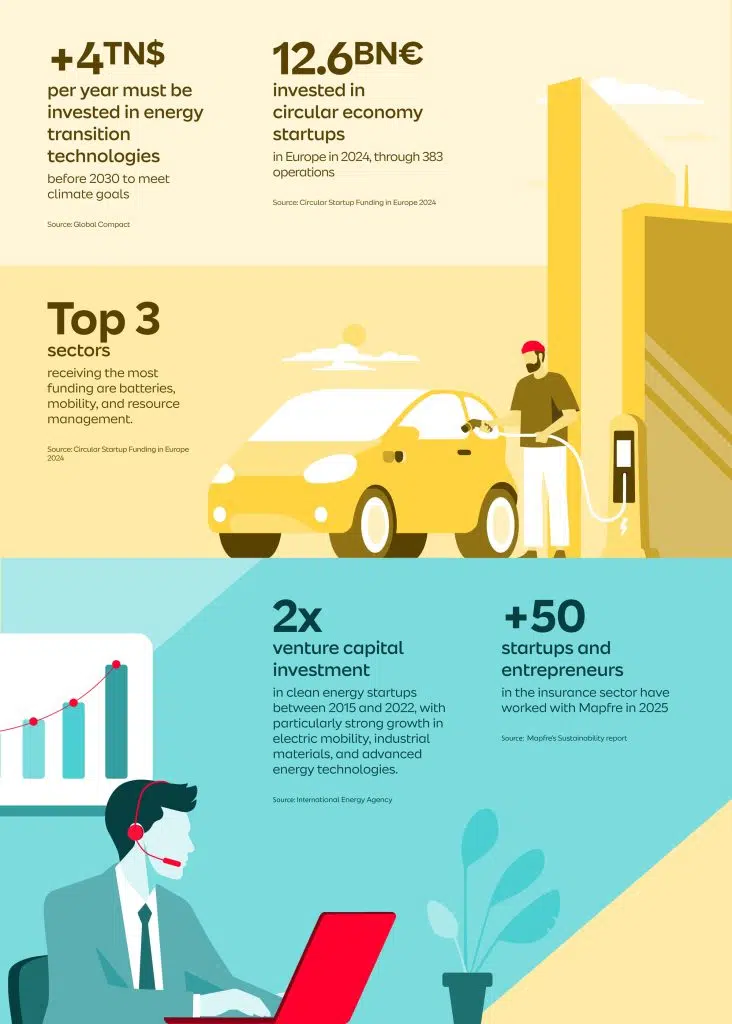
Europe has become one of the main drivers of this phenomenon. According to the report Circular startup funding in Europe 2024, funding for circular economy startups in Europe has entered a more mature phase, and the annual outlook reflects the sector’s structural growth, with total funding reaching €12.6 billion in 2024 across 383 deals. The report highlights the growing weight of sectors such as batteries, mobility, and resource management, evidencing both the consolidation and the specialization of the European circular ecosystem.
Data from the International Energy Agency confirms that investment in clean energy startups has grown significantly in recent years, especially in areas such as electric mobility, new materials, or industrial technologies, reinforcing an increasingly diverse and global ecosystem. This progress responds to a combination of factors: ambitious public policies—such as the European Green Deal—increased availability of funding and growing social awareness.
One of the most significant changes has been the change in risk perception. For years, sustainability investments were considered uncertain or unprofitable. Today, however, the solutions linked to the ecological transition are not only necessary but also economically competitive. According to the report Fostering Effective Energy Transition 2024 from the World Economic Forum (WEF), more than 80% of the growth in global electricity capacity in recent years now comes from renewable energy, while technologies such as photovoltaic solar and wind have become the cheapest options in most markets. This evolution has strengthened investment confidence and has contributed to a strong capital mobilization. The WEF itself points out that investment in energy transition technologies will need to exceed $4 trillion annually before 2030 to meet climate targets, further reinforcing a sustained wave of funding toward green technology. This shift in perspective has unleashed an unprecedented wave of investment in the green technology space.
The case of the Dutch company RIFT is illustrative. Its co-founder, Mark Verhagen, drove the development of iron fuel cells with the aim of decarbonizing energy-intensive industries. A project that reflects the growing interest in solutions capable of transforming sectors traditionally difficult to electrify.
And it’s not an isolated case: In 2015, Ronnie Mogensen, then a master’s degree student at Uppsala University, came across a study on sodium batteries by scientist and Nobel Prize winner John B. Goodenough. That reading sparked an idea: to explore more sustainable alternatives to traditional batteries. To do so, he began working with his professor Reza Younesi and with materials expert William Brant. Together they developed a new material that could serve as the basis for this type of battery. That initial breakthrough, born in an academic setting, would eventually lead the trio to found Altris in 2017, with the aim of bringing the technology to market and offering a more accessible and sustainable alternative.
In Paraguay, Verónica Alegre and Maura Martí developed a leather alternative made from mango waste, turning an agricultural problem into a new productive opportunity and founding the company Maigotex. In China, entrepreneur Supa founded the brand HowBottle, which transforms plastic bottles into design-driven products, showing that the circular economy can also be appealing to consumers. And in Africa, initiatives like the SURGE program in Ghana support emerging green companies that combine sustainability and economic development.
Collaboration is needed to overcome the obstacles
However, the growth of this type of initiative is not without challenges. Access to early-stage funding remains one of the main barriers, especially in projects that require large initial investments. Added to this is the need for stable regulatory frameworks and more precise tools to measure the real impact of the initiatives. The lack of common standards makes it difficult to compare projects and, at times, limits investor confidence.
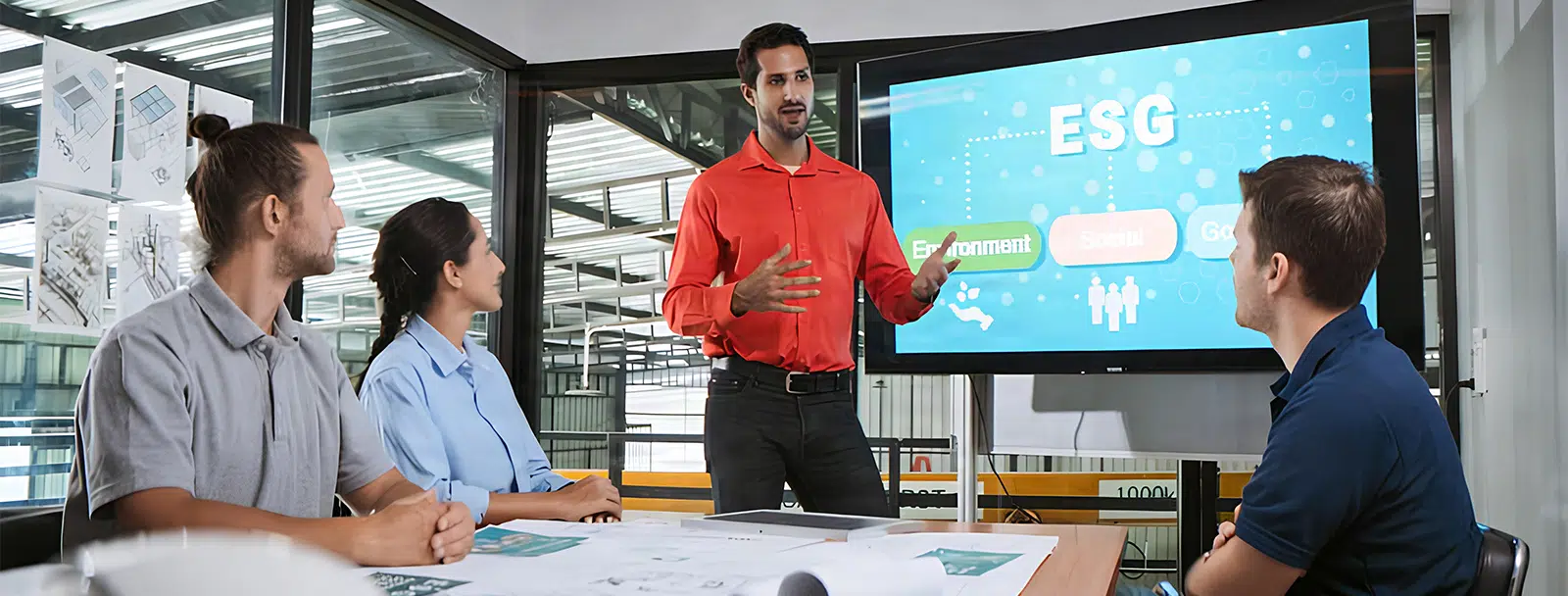
In this context, collaboration between public actors and private actors is essential. Incubation, acceleration, and specific funding programs are contributing to strengthening the entrepreneurial ecosystem. At the same time, the integration of ESG criteria in investment decisions is driving a greater alignment between profitability and sustainability. Education and training also play a key role in preparing new generations of entrepreneurs to develop innovative solutions.
At Mapfre, we understand that green entrepreneurship represents a strategic opportunity to advance towards a more sustainable economic model. It’s not just about adapting to a changing environment, but about actively contributing to its transformation. As we state in our latest integrated report, support for sustainable entrepreneurship is part of a vision aimed at generating long-term value, both for society and for the business itself.
Our commitment is reflected, for example, in collaboration with academic institutions and social innovation programs that identify and support projects with high impact potential, such as the Fundación Mapfre Social Innovation Awards that we organize together with IE University. These awards support innovative solutions with the potential for significant social impact in sectors such as health, mobility, digital technology, and the silver economy. We are looking precisely for entrepreneurs who, with their ideas, are transforming social and environmental challenges into inclusive and sustainable business opportunities.
The role of large corporations is, in this sense, increasingly relevant. Beyond their own sustainability strategies, they can act as platforms that accelerate innovation, connecting startups with markets and facilitating the adoption of new solutions. This relationship is bidirectional: startups provide agility and creativity, while corporations offer scale and capacity for implementation.
Green entrepreneurship is not a passing fad, but a structural response to the challenges of the present. Its ability to generate innovative solutions, create employment, and transform production models makes it a true catalyst for opportunities in a world that needs, more than ever, new ways of growing.