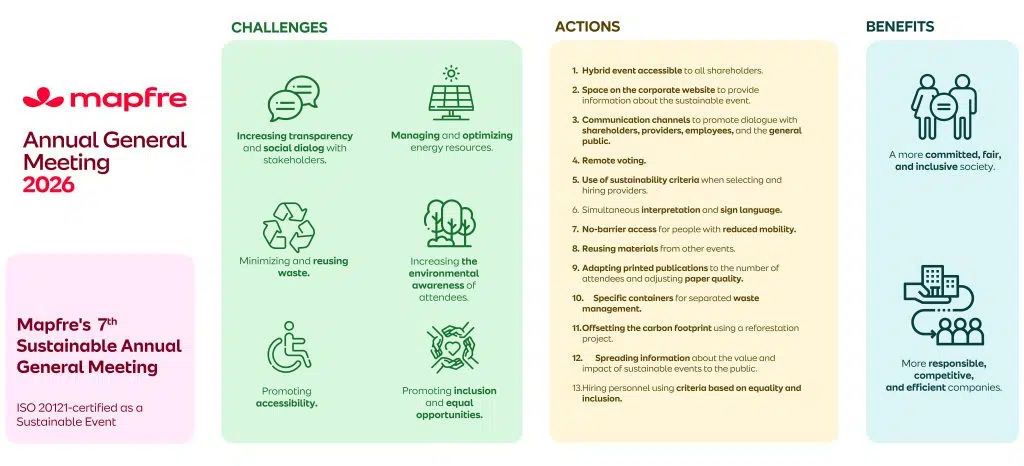
On March 13th, Mapfre held its Annual General Meeting, which was certified as a sustainable and carbon-neutral event for the seventh consecutive year. Fortunately, more and more events are being planned according to sustainability standards, from small corporate workshops to large-scale gatherings like COP30, and even music festivals such as Sonidos Líquidos, held on the island of Lanzarote in Spain. But do we really understand what it takes to organize this kind of event?
Susana Pelegrín Preixens, Sustainability Category Manager at AENOR and a certification specialist, explains: “A sustainable event manages and reduces its environmental, social, and economic impact while maximizing its benefits to the local area, community, and attendees.” In other words, it takes more than just a climate-based approach. In fact, the ISO 20121 standard was updated in 2024 to broaden its scope to encompass social issues and the supply chain.
Since then, an event can no longer be considered sustainable if it focuses solely on its environmental footprint—minimizing emissions, optimizing energy use, prioritizing renewable sources, and reducing waste. Ensuring universal accessibility is now equally non-negotiable, so that everyone can participate on equal terms. Pelegrín adds that it’s also essential to “protect human rights and children’s rights throughout the entire value chain, and to ensure the well-being and safety of staff, attendees, and the host community.”
To see what this looks like in practice, consider the examples offered by Bioevents, an agency that specializes in sustainable event management. “We prioritize venues that hold environmental certification or that have been designed to meet universal accessibility, among other considerations. We have strategies in place to cut food waste and streamline waste reduction processes, and we include people with intellectual disabilities on our team,” says Patricia Méndez, CEO and founder of the agency—and a mother of two children with disabilities.
One of Bioevents’ real strengths is its host and support staff. “We have a diverse team of men and women that includes people with disabilities, senior staff with long careers behind them, and junior staff. They’re fully qualified and properly trained to take on any role, bringing an extra layer of humanity to our inclusive events,” Méndez notes.

Patricia Méndez (Bioevents): “We have strategies in place to cut food waste and streamline waste reduction processes, and we include people with intellectual disabilities on our team.”
Then there’s the question of responsible procurement. As Susana Pelegrín points out: “It’s important to choose providers who are committed to ethical and environmental standards, who manage resources efficiently to avoid unnecessary costs, and who support the local economy wherever possible.”
Paying attention to every detail is what makes an event truly sustainable. Take décor, for instance. As Patricia Méndez explains, “We design and build sets using recycled and cardboard materials. Every decorative element is conceived to minimize environmental impact, encouraging reuse and mindful consumption.”
Susana Pelegrín (AENOR): “It’s important to choose providers who are committed to ethical and environmental standards, who manage resources efficiently to avoid unnecessary costs, and who support the local economy wherever possible.”

Obtaining certification requires ongoing dialogue with stakeholders, anticipating risks and opportunities, and impact assessments before, during, and after the event. In other words, it’s essential to “ensure consistency across every decision, involve all parties, measure what truly matters—not measuring everything, but measuring well—and keep transparency and credibility at the forefront,” explains the AENOR expert.
Although this requires enormous effort, the results speak for themselves and deliver substantial benefits:
- Reduced environmental impact: less waste, lower emissions, smarter resource use.
- Cost optimization through efficient resource use, reduced waste, and better-organized processes.
- Greater satisfaction and engagement among stakeholders (teams, attendees, sponsors, and communities).
- Stronger relationships with local communities, avoiding conflicts over noise, waste, or infrastructure strain.
- Contributing to the SDGs and aligning with sustainable regulations and investment frameworks.
- Enhanced reputation and brand image, demonstrating a genuine commitment to sustainability to sponsors, customers, and attendees.
The reality is that a growing number of companies—and even SMEs— are making sustainability a priority in their events, following the trail blazed by Mapfre seven years ago. “Both businesses and public institutions are showing increasing interest in holding more responsible events that align with their ESG commitments. Demand for transparency, impact measurement, and legacy creation has grown considerably in recent years,” Pelegrín observes.
At Mapfre, we’re proud to be among the first IBEX 35 companies to seriously bring such a strong sustainability focus to our Annual General Meeting—and we’ve raised the bar every year since. That’s why we were able to meet our goals last week: strengthening transparency and social dialogue with stakeholders; managing and optimizing energy resources; minimizing and reusing waste; raising awareness among attendees and staff; promoting inclusion and equality; and ensuring accessibility.
As a final step, the event’s carbon footprint will be calculated and the resulting CO2e emissions will be offset by funding a reforestation project to restore a fire-damaged area of Spain.