
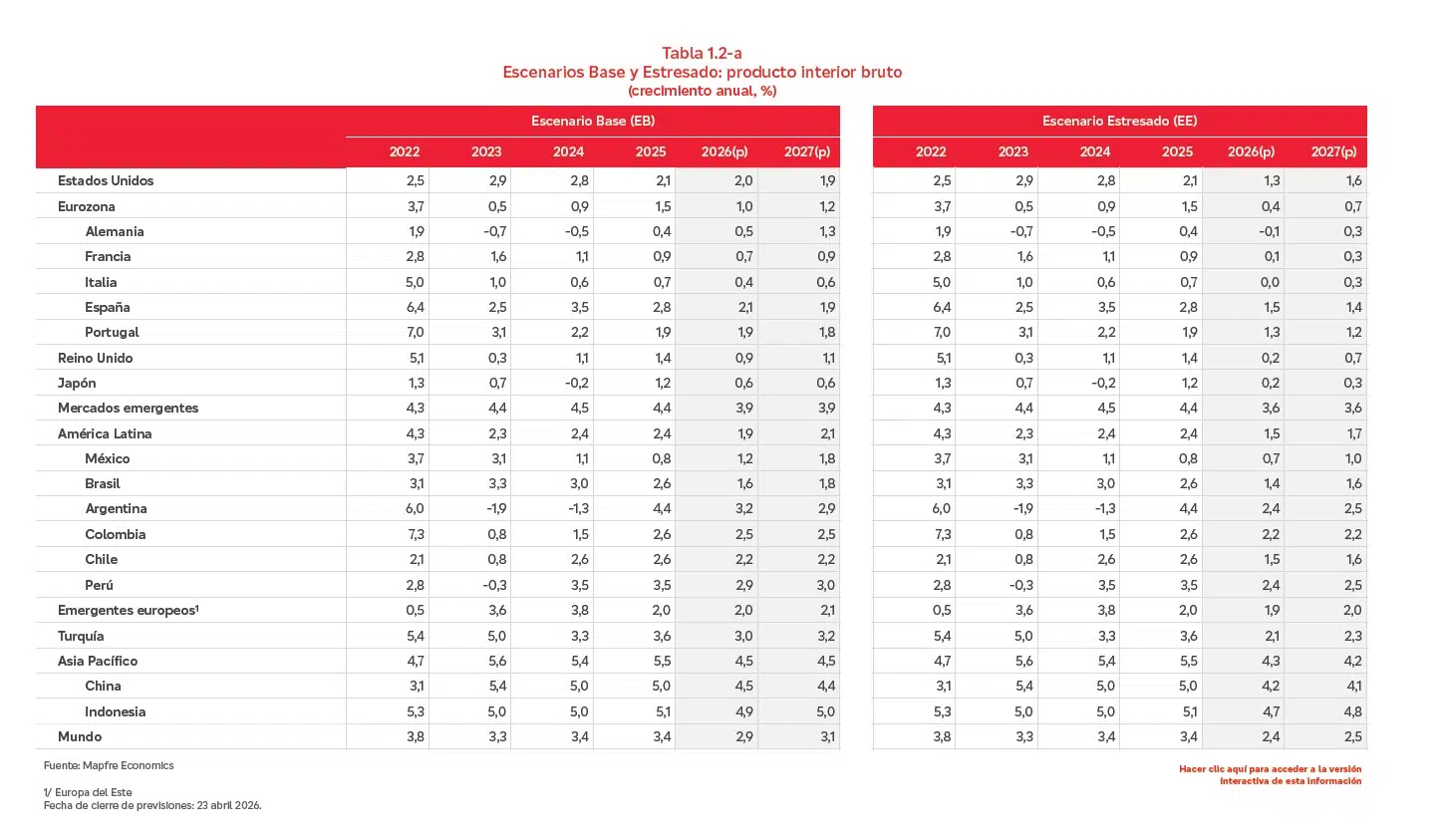
Mapfre Economics, Mapfre’s research arm, has revised the growth forecast for the global economy and places it at 2.9% this year and 3% next year, with inflation of 3.7% and 3%, respectively. This is highlighted in its report “2026 Economic and Industry Outlook: Second-Quarter Forecast Update,” published by Fundación Mapfre.
Mapfre Economics explains that the global economic cycle is moving towards a “stagflationary” environment, driven by geopolitical tensions, logistical disruptions, and energy shocks “Geopolitics is consolidating itself as the guiding axis, subordinating monetary policy to rigorous risk management,” it notes.
At the regional level, the impact is asymmetric. The United States appears, in principle, better positioned to absorb several months of higher inflation, thanks to its status as an energy producer, the flexibility of its productive base, and the depth and sophistication of its financial markets, which act as significant buffers against the shock. The growth estimate is set at 2% for this year and 1.9% next year, with inflation of 3.3% and 2.1%, respectively.
Europe, for its part, will continue to grow, but at a weaker pace than previously expected and under a regime of higher and more volatile inflation, shaping a transitional scenario rather than a clearly defined trajectory. In the short term, the most likely outcome is a period marked by persistent inflationary pressures driven by energy and transportation costs. In this context, Mapfre Economics forecasts that the economy of the Old Continent will grow by 1% in 2026 and 1.2% in 2027, with price increases of 2.5% and 2%, respectively.
Asia faces an impact similar in nature to Europe’s, but potentially more delicate due to its greater direct exposure to energy trade and the affected maritime routes. Accordingly, the region is expected to post growth of 4.5% this year and the same figure next year, with inflation of 1.3% and 1.4%, respectively.
Lastly, Latin America faces the impact of the conflict under a less homogeneous and, on average, less adverse scenario than Europe or Asia, though still shaped by the same geopolitical drivers. Mapfre Economics forecasts regional GDP growth of 1.9% this year and 2.1% next year, with inflation rising by 8.8% and 7.8%, respectively.
Impact on the insurance industry
The insurance industry shows a certain resilience, leveraged by the nominal growth derived from inflation, although subject to marked financial volatility. The Life segment is managing to hold steady through investment returns, while the Non-Life segment will require strict underwriting discipline and pricing adjustments to mitigate the erosion of operating margins amid rising claims costs.
Thus, Mapfre Economics anticipates a global improvement of Life insurance premiums of 5.4% this year and 6.7% next year, while Non-Life premiums will increase by 5.5% in 2026 and 6.4% in 2027.