There is something deeply human about closing the front door and knowing everything is in order. That simple act defines home as our primary refuge – a place of safety where we can rest and feel protected. But when we broaden our perspective, we realize that our home extends far beyond those four walls. It reaches into the forests, oceans, and natural systems that sustain life on Earth. This perspective has become even more relevant in light of the recent images captured by NASA’s Artemis II mission during its journey around the Moon. From space, Earth appears as a single, shared home. When we truly grasp the scale of what “home” means, our understanding of what it means to care for it changes as well. According to the United Nations Environment Programme (UNEP), nature degradation is already affecting the well-being of at least 3.2 billion people. Protecting the environment is therefore the most direct way to safeguard our own well-being and care for the place we all call home.
The link between ecosystems and companies
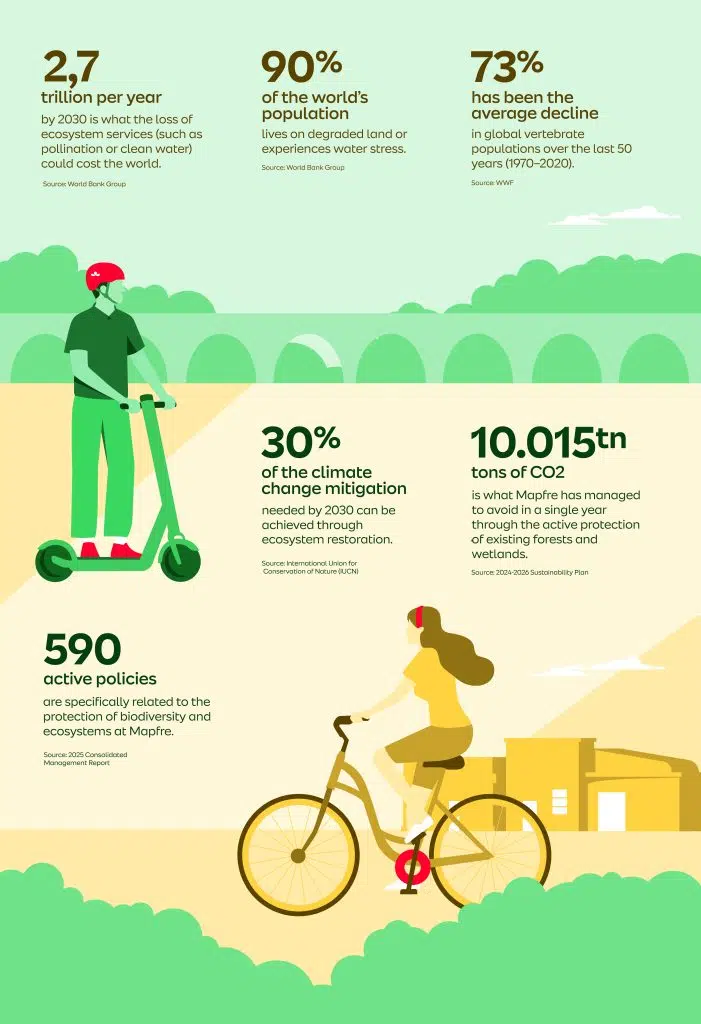
Ecosystems – such as wetlands, forests, and rainforests – serve as life-support systems, regulating the essential natural processes we depend on to survive. According to a report by the Intergovernmental Science-Policy Platform on Biodiversity and Ecosystem Services (IPBES), more than 50% of global GDP depends on nature and the ecosystem services it provides. Yet this dependence stands in stark contrast to the pace at which we are degrading those very systems. According to the Living Planet report by the WWF, 73% of vertebrate populations have been lost between 1970 and 2020. This has far-reaching consequences. In the face of this growing global vulnerability, the role of businesses has become more important than ever. The climate crisis calls on companies to become active agents of restoration. Like every individual, businesses are part of the broader ecosystem and depend on a stable climate and healthy natural resources to thrive. Today, a growing number of companies are leading projects with a genuine, on-the-ground commitment to nature. One example is Patagonia, the outdoor apparel company widely recognized for its leadership in protecting wild ecosystems. Since 1985, Patagonia has pledged 1% of its sales to environmental organizations and actively supports initiatives focused on conserving natural landscapes and restoring ecosystems. Its approach demonstrates that business success and environmental stewardship can go hand in hand.
A commitment to the planet
At Mapfre, We have made the protection of biodiversity and natural capital a strategic priority that is embedded across all our international operations. Our commitment is rooted in the belief that the insurance sector is, by nature, a risk manager – and today, there is no greater risk than the degradation of our environment. At the company, we are moving towards emissions neutrality in our main markets by 2030. We should also highlight that, in 2024, we reported a 25% reduction in our carbon footprint compared with the 2022 baseline, exceeding expectations by 15 percentage points. In addition, we are promoting sustainable investments, with more than 95% of our investments aligned with ESG criteria. According to our latest Integrated Report, Mapfre has 590 active policies specifically related to the protection of biodiversity and ecosystems, generating nearly €2.5 million in premium volume in 2025. But our work goes beyond this, as we focus on restoring nature through reforestation and ecosystem restoration projects in the various regions where we operate.
Projects with impact
Habitat preservation is one of the most effective ways to act against climate change, especially when approached from a global perspective. In 2024, at Mapfre, we have offset part of our operational carbon footprint by supporting projects that combine sustainable forest management and avoided deforestation across different territories. In Puerto Rico (846 tCO₂), Peru (2,514 t) and Mexico (3,137 t), these initiatives have helped protect key ecosystems, from the Amazon rainforest to the Sierra Madre Occidental, avoiding emissions and strengthening biodiversity. This commitment extends to particularly sensitive regions such as Brazil, where we have offset 3,518 tons of CO₂ through the protection of the Pantanal, one of the most valuable tropical wetlands on the planet. Businesses cannot thrive in a deteriorating environment, because the stability of any company depends on the health of the natural systems that surround us. Ultimately, protecting ecosystems is the most genuine way to care for our own home, because only when the planet is in balance does that everyday gesture of closing the door and feeling that everything is in order regain its full meaning.