
Human beings are, above all, social beings. Unlike other species that survive through individual strength, we thrive because of our ability to cooperate, organize ourselves, and build stable relationships. From the earliest communities to modern societies, collaboration has made it possible to share resources, transfer knowledge, and sustain social cohesion. Life in connection with others is the very foundation of social harmony.
This relational logic continues when people create companies. After all, a company is born from human decisions and, therefore, reflects the same need for constant interaction. They are built on trust and defined by the quality of their relationships – with customers, employees, suppliers, shareholders, regulators, and other stakeholders. All are part of an ecosystem in which no one can act unilaterally without consequences.
Traditionally, principles such as respect, active listening, and attentiveness have guided these relationships. However, the 21st century, shaped by climate change and profound social transformations, has introduced a factor that is redefining the way corporate collaboration is understood: sustainability.
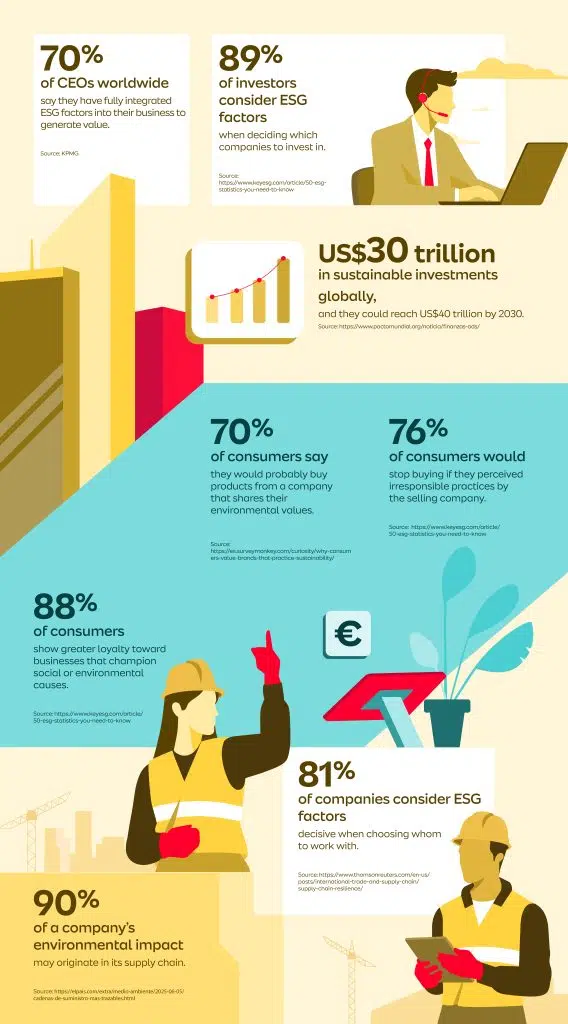
Current business cooperation requires integrating environmental, social, and governance (ESG) criteria into decision-making. In fact, nearly 70% of General Managers worldwide state that they have fully integrated ESG factors into their business to generate value, according to data from KPMG. This trend responds to the conviction that a solid sustainability proposal can provide long-term success. An increasing number of investors demand it – 89% consider ESG factors when deciding which companies to invest in – and sustainable investments have already surpassed $30 trillion globally, confirming that integrating ESG criteria also contributes to financial performance.
Customers as allies in sustainability
Customers are at the heart of this transformation. Several studies show that a majority of consumers adjust their purchasing decisions based on the sustainable commitment from companies: 70% state that they would likely buy products from a company that shares their environmental values. On the contrary, 76% would stop buying from a company if they perceived irresponsible practices. Likewise, 88% of consumers show greater loyalty towards businesses that champion social or environmental causes.
In response to this reality, companies are integrating sustainability into their value propositions. In the financial services and insurance sectors, this translates into developing products and services that enable customers to align their decisions with their values while better managing emerging risks. It also involves maintaining ongoing dialogue to understand expectations and anticipate regulatory and social changes.
Insurance underwriting is one of the areas where this integration is most tangible. At Mapfre, sustainable underwriting is supported by an internal assessment model that evaluates the ESG risks associated with each transaction, taking into account the sector, business activity, and geographic markets in which customers operate. This analysis enables us to anticipate impacts, establish risk thresholds, and guide decision-making toward more resilient scenarios. It is further complemented by policies that reflect our commitment to a low-carbon economy and respect for human rights. In 2025, we strengthened this commitment through the approval of the new Sustainable Underwriting Framework, which establishes the rigorous application and compliance with criteria designed to create greater sustainable value for customers and generate a positive impact on the environment.
The supply chain can also (and should) be collaborative
If customers are a driver of change from the demand side, suppliers and the value chain are so from the supply side. Much of a company’s environmental impact is generated beyond its direct operations. It is estimated that up to 90% of this impact may originate within their supply chains, which explains why an increasing number of companies are integrating ESG criteria into the selection and management of their suppliers. In this regard, 81% of companies consider ESG factors to be decisive when choosing which partners to work with.
Sustainable supplier management typically begins with clear codes of conduct and robust compliance frameworks. At Mapfre, we manage our supplier relationships within a rigorous framework that goes beyond formal oversight. Collaboration involves working together to improve practices through audits, regular assessments, training, and support to help business partners adapt to increasingly demanding sustainability criteria. Since 2019, we have had an ESG supplier qualification methodology in place that enables us to assess our suppliers across areas including quality, sustainability, ethics, compliance with legal requirements, and operational performance. As detailed in our latest Integrated Report, in 2025 we qualified more than 18,000 suppliers across more than ten countries based on ESG criteria, representing a significant increase compared with the previous year.
Ultimately, at Mapfre, we know that sustainability is a collective effort. Only by working hand in hand with all our stakeholders will we achieve a positive long-term impact. This way, we can continue contributing to the development of a more equitable, safe, and respectful society with the planet. And that commitment will continue to be an indispensable priority on our corporate agenda.