
The alarm goes off on our phones. We reply to our first texts before getting out of bed, check email on our computers, track our steps on our smartwatches, and end the day by streaming a series in our living rooms. Technology is woven into every part of our daily lives. This network of devices and screens has transformed the way we work, move around, and relate to one another. But it also leaves behind an invisible trace that does exist: the so-called “digital carbon footprint.”
Every digital activity we perform generates CO₂ emissions through the energy consumed by servers and devices. Behind these technologies lies a vast global physical infrastructure that requires a constant supply of electricity, cooling systems, and critical materials. Digital technology therefore has a real environmental impact. Recognizing this dual reality—that technology is essential to building a more sustainable model, while also carrying its own energy costs—is the first step toward understanding its impact and managing it more effectively.
Actions that leave a footprint
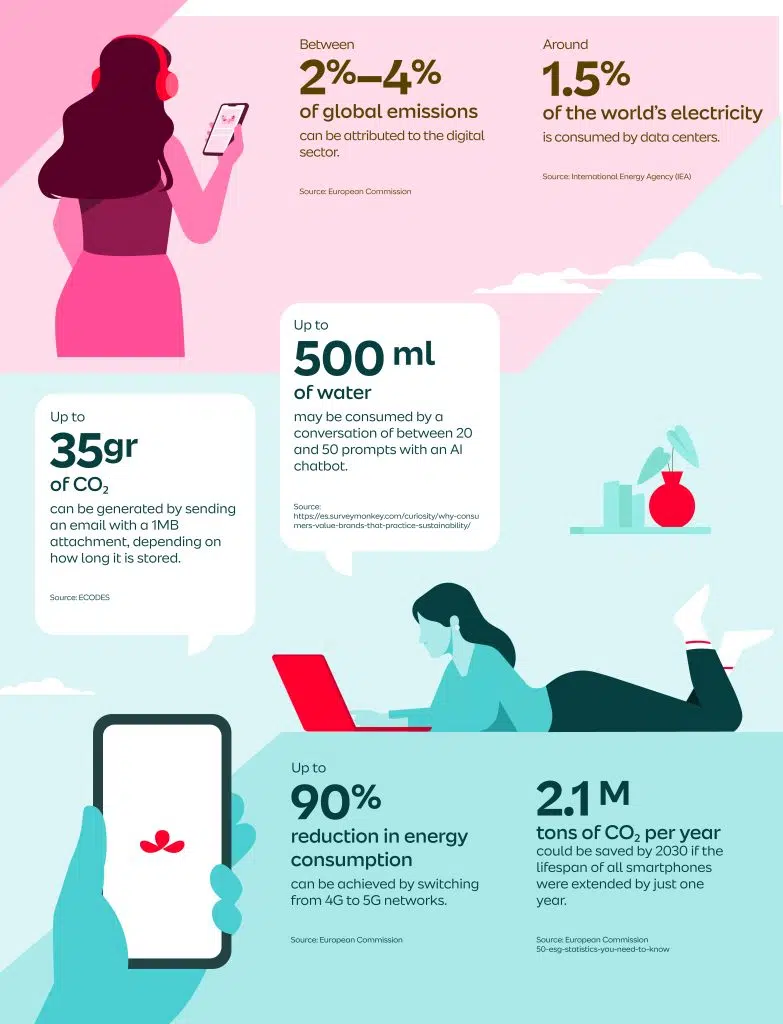
A digital carbon footprint is the greenhouse gas emissions generated by our use of information and communications technologies (ICT). According to ECODES, ICT currently accounts for between 2% and 4% of global greenhouse gas (GHG) emissions, a figure that could increase twofold by 2040 if no action is taken. According to the International Energy Agency (IEA), data centers and data transmission networks account for around 1.5% of global electricity consumption, and their electricity demand is expected to more than double by 2030. This energy impact is compounded by water use, as large data centers rely on cooling systems that can require millions of liters of water per year, especially in regions with high temperatures. According to a recent study by researchers at the University of California, Riverside, and the University of Texas at Arlington, titled Making AI Less “Thirsty”:Uncovering and Addressing the Secret Water Footprint of AI Models, in 2021 alone, Google’s AI data centers in the United States used approximately 12.7 billion liters of water to cool their facilities. 90% of that water was potable.
Connectivity and sustainability in balance
Digitalization is key to achieving the Sustainable Development Goals and accelerating the ecological transition, but it must be guided by energy efficiency, circular economy, and shared responsibility. Solutions are already being implemented at different levels:
- More efficient infrastructure: Major data center operators are investing in renewable energy, advanced cooling systems, and improvements in PUE (Power Usage Effectiveness), which measures these facilities’ energy efficiency. The trend is toward carbon-neutral data centers and, in some cases, recovering waste heat for urban or industrial use.
- Responsible device design and use: Ecodesign, repairability, and reuse are key to reducing the footprint associated with manufacturing. Regulatory initiatives in different regions of the world are promoting the right to repair and more demanding efficiency standards.
- Conscious digital habits: Users can also help reduce their footprint by optimizing cloud storage, avoiding unnecessary mass email sends, lowering streaming quality when high resolution is not essential, and extending the useful life of devices.
- Measurement and transparency: You can’t manage what you don’t measure. More and more organizations are integrating their digital footprint into their climate strategies, including specific indicators in their sustainability reports.
Mapfre and its actions
At Mapfre, we recognize climate change as one of the greatest global challenges and are committed to helping mitigate its impact. That’s why, for years, we’ve rigorously measured and managed our carbon footprint. According to our latest Integrated Report, in 2025, the Group’s carbon footprint was reduced by 24% compared with 2022, exceeding the 21% reduction target set for this year. These achievements reflect our ongoing commitment to sustainability and climate change mitigation, driven by the procurement of renewable electricity, improvements in building energy efficiency, and the optimization of internal processes.
We understand that digital transformation and sustainability must go hand in hand. That’s why digitalization forms part of our global strategy, and why we are aware that it also brings environmental responsibilities. Electronic signatures, process automation, and the promotion of digital channels have reduced the consumption of material resources and travel associated with insurance activity.
But we don’t simply digitalize. We also analyze the energy impact of our technology infrastructure and work to ensure that our providers share demanding environmental standards. Our approach combines common corporate guidelines with action plans adapted to each local context, with the aim of reducing the Group’s operational carbon footprint by 25% by the end of 2027. Ultimately, the digital carbon footprint is the result of technological, energy-related, and cultural decisions.
The good news is that we have the knowledge and tools needed to reconcile connectivity with environmental protection. Well-guided innovation can reduce more emissions than it generates, and digitalization, when managed according to environmental criteria, can be a decisive ally in the ecological transition.