
A good savings strategy should be tailored to each person’s circumstances and needs. However, experts agree that one of the most effective approaches is to save regularly, setting aside a comfortable amount each month to build wealth and improve your financial future.
As the infographic shows, a monthly contribution that may not seem particularly large at first, such as €50, can add up to a substantial amount over time. But the chart also makes one thing clear: there is a huge difference between simply putting that money aside and investing it.
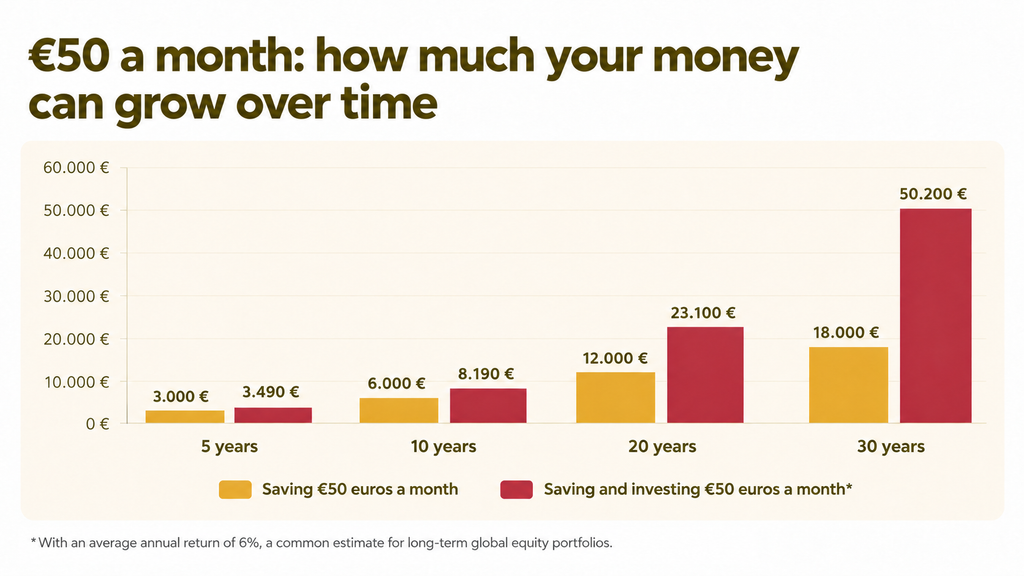
After five years, the results are already becoming apparent, with gains of almost €500. After 10 years, the accumulated interest is equivalent to several years’ worth of contributions at the chosen monthly amount. After 20 years, someone who had invested their savings would have nearly doubled their money.
The estimated investment returns are based on an average annual return of 6%, typical of a globally diversified equity portfolio. Over the long term, historical returns have been closer to 7%, making this a conservative estimate.
The difference lies in compound interest
Behind this difference lies one of the most important concepts of personal finance: compound interest. Unlike traditional saving, where our money grows only through the additional contributions we make, investing allows the returns we earn to generate returns of their own.
This means that, over time, every euro earned works to generate even more gains. Growth may seem modest in the early years, but it accelerates as time goes on. That’s why, when investing, time is often just as important as the amount contributed. The key is consistency.
Long-term investing helps reduce risk
Long-term investing can also help reduce risk and lessen the impact of market fluctuations. By making regular contributions, you buy assets when prices are both higher and lower, smoothing out the effects of volatility and eliminating the need to try to time the market.
Future returns are not guaranteed, and all investments involve risk. However, historical evidence shows that investors who follow a disciplined strategy and maintain a long-term investment horizon are generally better positioned to benefit from the markets’ growth potential.
As we’ve seen, the best approach to saving is to think long term, make regular contributions, and combine saving with investing. Given a sufficiently long time horizon, this strategy can make a significant difference to the rewards you reap from your saving efforts.