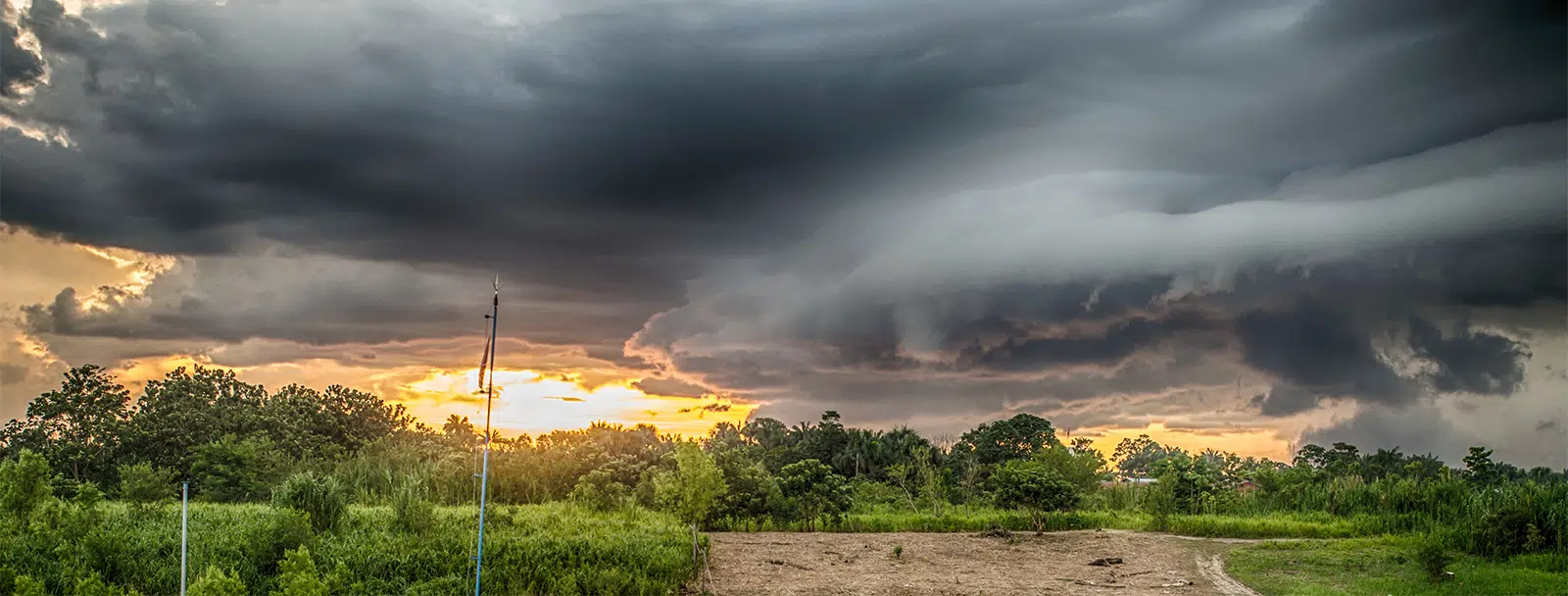
Latin America’s natural conditions make it one of the regions most prone to natural disasters. Both those of atmospheric origin (hurricanes in both oceans, droughts, floods, and more), which account for roughly nine out of every ten such events, and non-atmospheric ones, including earthquakes and volcanoes in a region with significant seismic and volcanic activity, pose a threat that Latin American countries are still struggling to adapt to.
Among other effects, natural disasters have been and continue to be an economic burden for the region. Manuel Aguilera, general manager of Mapfre Economics, Mapfre’s research arm, points to the vulnerability that Latin America faces due to the high population density of low- and very-low-income groups, as well as the concentration of assets in large cities or tourist areas exposed to natural disasters.
Thus, when one of these extreme phenomena strikes and spreads its devastation, in addition to the loss of life, it causes material and economic damage to these communities, damage for which countries are often unprepared, leaving entire regions economically depressed and taking years to recover their activity.
Traditionally, the immediate response to these disasters comes from public funds, which bring greater debt or additional fiscal burden, or from external aid. “But the one thing that is almost always left out of the equation is insurance,” said Manuel Aguilera at a roundtable discussion on this issue held at the 11th Meeting of Multilatina Companies, recently held at the Menéndez Pelayo International University (UIMP) in Santander.
The general manager of Mapfre Economics illustrated this with two specific cases that occurred in Mexico. In 2005, Cancún and the Riviera Maya were hit by Hurricane Wilma, which reached Category 5, with enormous destructive power. However, the area had a high level of insurance coverage, and much of the response came from insurance, which enabled a rapid economic recovery.
By contrast, Hurricanes Ingrid and Manuel struck almost simultaneously in 2013, causing especially severe damage in Acapulco, where insurance coverage was very limited. Without a sufficient immediate response, this situation led to a prolonged economic impact, with the consequences dragging on for years for the affected population.
Overall, Mapfre Economics’ latest estimate puts the Insurance Protection Gap—that is, the difference between existing insurance coverage ($215 billion, about €186 billion) and the level that would be economically necessary and beneficial for society—at $316 billion (about €275 billion). The optimal level is therefore about 2.5 times the current one.
However, insurance “is necessary but not enough,” warns Manuel Aguilera. The potential damages from a natural disaster are too vast to be fully absorbed by private companies alone, at least under standard arrangements. This “market failure” has been successfully addressed in numerous international cases through public-private partnerships.
Under this model, providing funds is more effective and less costly to society when done proactively, ahead of time, rather than after the event occurs. Establishing a large fund during periods of normalcy to respond to these situations would be the ideal solution, which is something that, among other factors, low insurance penetration has prevented in Latin America.
One example of this approach is Spain’s Insurance Compensation Consortium. This organization obtains its funding from a small surcharge added to every insurance policy taken out in the country. Thus, when one of the situations covered under its mandate occurs (floods, earthquakes, hurricanes, etc.), it is the Consortium itself, rather than each individual insurance company, that takes charge of the corresponding compensation payments. It is, therefore, a solidarity mechanism that guarantees the economic cost of the catastrophic event is covered, a cost that might otherwise exceed the capacity of private companies.
It is a technical solution that already exists and has proven effective in various parts of the world, Manuel Aguilera emphasizes, and it does not require a large mobilization of resources that could strain public finances, but rather a long-term vision. The barriers to implementing it are, for now, institutional in nature.
The economic impact of natural disasters will remain a reality, and the trend points toward rising costs. The challenge is to ensure protection mechanisms that allow this impact to be distributed as sustainably as possible.