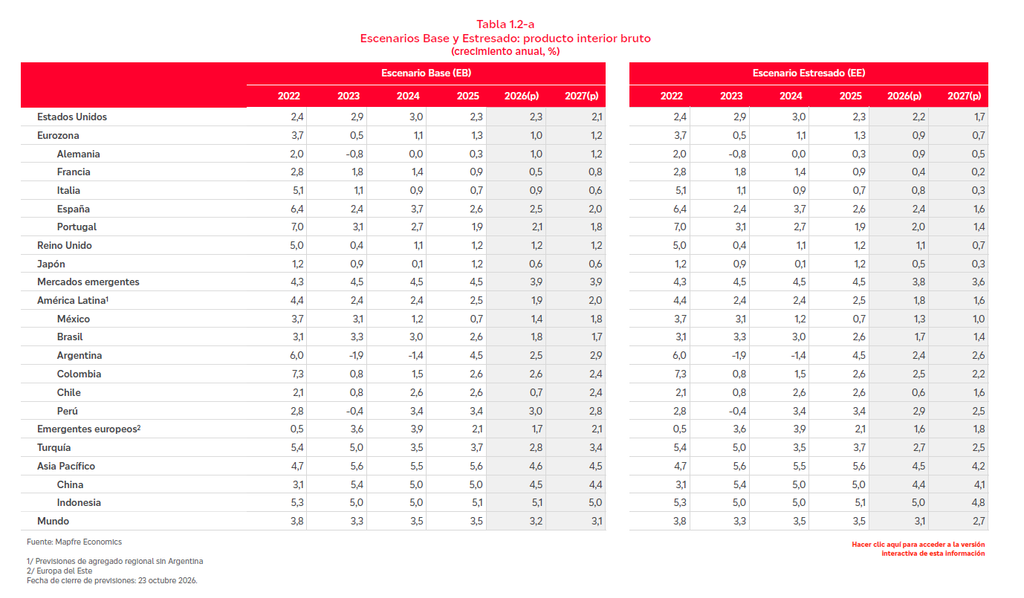
Mapfre Economics, Mapfre’s research arm, has raised its global growth forecast to 3.2%, two-tenths of a percentage point above its previous projection, and has held its 2027 estimate at 3.1%. Inflation is expected to come in at 4.5% and 4%, respectively. These are among the key findings of the report Economic and Industry Outlook 2026: Fourth-Quarter Forecast Update, released Thursday and published by Fundación Mapfre.
The global economy is entering the final stretch of 2026 against a backdrop still defined by significant sources of uncertainty, coupled with a degree of macroeconomic resilience greater than those risks would initially suggest. Geopolitics remains at the center of it all, continuing to exert a decisive influence on the global economic environment and marking the line between the baseline scenario and the tail risks.
Since the end of summer, some particularly uncomfortable questions about the persistence of inflation have resurfaced. These concerns are no longer confined to oil or to the risks surrounding the Strait of Hormuz; they have spread to other key segments of the energy supply chain, tempering some of the prevailing optimism about the pace of disinflation and putting inflation back at the center of the monetary policy debate.
The United States is projected to grow 2.3% in 2026 and 2.1% in 2027, with inflation of 3.4% and 2.6%, respectively. Economic activity has continued to be underpinned by strong consumer spending, a labor market that is still creating jobs, business indicators that remain in expansionary territory, and investment that continues to benefit from both the technology cycle and fiscal stimulus.
Eurozone GDP is expected to grow 1.0% this year and 1.2% next year, with inflation of 3.1% and 2.7%, respectively. Europe faces a more modest trajectory than other major advanced economies, and the focus of the economic debate appears to be gradually shifting from the strength of the recovery to the region’s ability to adapt to a structurally challenging environment.
Mapfre Economics projects growth of 1.9% in 2026 and 2.0% in 2027 for Latin America, with inflation of 8.7% and 8.5%, respectively. The regional economy continues to benefit from a macroeconomic environment that is relatively favorable compared with the rest of the emerging-market universe, although there are marked differences among some of the region’s economies, such as Brazil and Mexico.
Asia, for its part, continues to account for a significant share of global growth, although it is increasingly shaped by the geopolitical and economic shifts that are redefining the global landscape. The region is expected to grow 4.6% this year and 4.5% next year, with inflation of 1.4% in both 2026 and 2027.
China is moving through a period of more moderate economic growth, supported by targeted government stimulus and the strength of certain industrial and technology sectors. Mapfre Economics forecasts GDP growth of 4.5% this year and 4.4% next year, well short of the government’s 5% target.
Industry outlook
Global insurance activity remains resilient, buoyed by the nominal boost from higher inflation (which is gradually feeding through to sums insured and premium rates) and by higher interest rates, which make savings products more attractive and improve investment portfolio returns. However, this support comes alongside growing divergence across markets and between the Life and Non-Life segments, as well as greater exposure to financial market volatility and tighter financing conditions.
Against this backdrop, global premiums are expected to grow 5.0% in nominal terms in Life insurance and 4.8% in Non-Life in 2026, slightly below the figures in our previous update, partly due to the base effect of a stronger-than-initially-estimated close to 2025. For 2027, premium growth is expected to accelerate to 5.7% in Life and 5.4% in Non-Life as the effects of repricing and higher investment returns take hold.