This increased safety in the value chain, which is key to preserving the quality of these foods, is also great news for consumers, who are increasingly interested in knowing everything regarding the products that reach their tables.
An upward trend
Without a doubt, there has been an increased demand to know the origin of foods consumed, whether they have been processed—and what that process was—as well as any other details that provide greater transparency.
After all, consumers are increasingly aware of the importance of proper nutrition and caring for the environment, another aspect that is reflected in the traceability of the supply chain.
In places such as Spain, this concern is growing, as indicated by the Barometer of trust in the agri-food sector prepared by the Ministry of Agriculture, Fisheries and Food, which shows that 70 percent of consumers check the information labels included on the food they buy.
In addition, a study by Morning Consult for IBM last December revealed significant figures: 52 percent of Spanish consumers would change their planned menu at Christmas if it were not sustainable; 65 percent want to consume foods that have been produced using ethical methods, and 59 percent say blockchain technology gives them the necessary confidence to know everything they want about a product.
Why blockchain?
Mapfre is part of several platforms that make use of this technology, such as B3i, a global initiative supported by 19 major investors in the insurance sector and a diverse community that currently comprises more than 40 companies. A year ago, it joined TIREA, Tecnologías de la Información y Redes para las Entidades Aseguradoras, to launch CYGNUS, the first blockchain network in Spain for use by the insurance industry in the coinsurance sector.
Without entering into very technical explanations about this technology, blockchain is characterized by the security it provides in transactions (not just for food, but for everything). This is because it has a decentralized and distributed database that eliminates the presence of intermediaries and whose encryption greatly prevents any attempted cyberattacks.
This is why its use in food traceability has increased. Moreover, the confidence shown by consumers should be of no surprise when taking into account the benefits it provides to the food sector, which can be summarized as follows:
- Improved quality. Controlling every step taken by an item of food from production to final sale, via processing, packaging, storage and transport, improves its quality, since it reaches the end consumer in perfect condition. The end consumer will also know that they have a product in their hands that has not been impacted in any way that could put their health at risk. Therefore, an increase in the quality of the process ensures a reduction in health risks.
- Less fraud. Blockchain ensures that there are no intrusions into food traceability. In other words, the possibility of fraudulent or deceptive practices is curbed at all stages through which the product passes on its way to the end consumer. “The records are all associated with the person or team that uploads them to the chain. If they are modified later, this is reflected and the other agents in the chain can be aware of this. It may therefore be a further barrier to fraud,” explains Miguel Flavian, founder of the food distribution consultancy GM&Co in Revista Alimentaria. Having said that, he also warns that, “it should be noted that the system is as strong as its weakest link. Who uploads the information? Is it to be trusted? That is why the current trend is to integrate more applications that allow the quality of the information being uploaded to be verified, such as associating authenticity information with the chain at its origin (DNA test, chemical or metabolic profiles of the product, etc.). This way, these tests can be repeated at the end and thus check that the product remains the same and there has been no substitution.”
- Optimized production. A greater understanding of the entire process that an item of food runs through from production to sale will result in the information needed to save both costs and time. These data will become increasingly valuable thanks to the popularization of the Internet of Things and by virtue of providing objects with the ability to communicate with one another. If this is combined with the imminent arrival of 5G technology, which increases both the quality and the quantity of connections, food sector companies will have a huge volume of information to optimize the whole process and improve sustainability.
The issue of sustainability
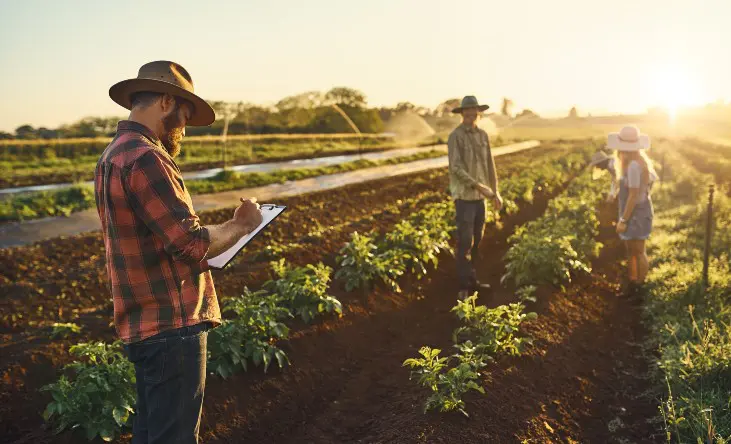
As stated earlier, environmental sustainability has also become a purchasing factor for end consumers, who do not want to participate in production processes that are harmful to the environment. At this point, the information and security provided by blockchain can help production companies carry out practices that are less harmful to the environment, in agriculture as well as livestock and fisheries.
Of course, we must also take into account the environmental footprint that the massive use of technology can cause. Miguel Flavian also commented on this in the article mentioned above, stating that “due to being decentralized and in order to validate a block, there must be a consensus among the different agents that store the information, multiplied by the large number of blocks that will be created when this is applied extensively. This can have a significant impact on the environmental impact of the company using it. The food industry is pursuing the efficiency and reduction of its carbon footprint, and when introducing these systems into its operation, this must also be considered. Along these lines, this is expected to be overcome over time and information management systems will be developed in the chains that have a smaller environmental impact.”
In any case, agencies like the United States Food and Drug Administration (FDA) are clear that the future is in blockchain technology. This “will allow food to be traced back to its origin in seconds and will use new data analysis techniques to strengthen the prevention of foodborne diseases, alerting consumers in real time before contaminated or mislabeled foods are consumed.”
Related materials