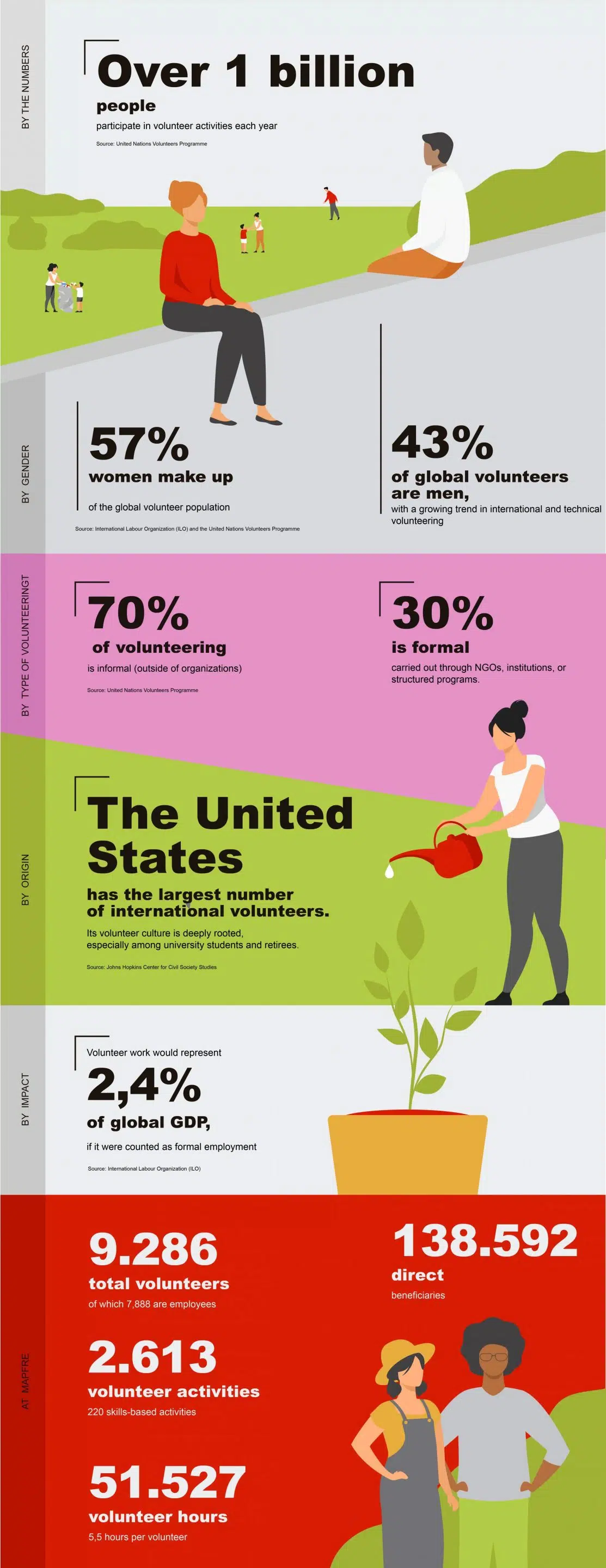
In a world grappling with persistent inequalities, a climate crisis in need of urgent solutions, aging populations and forced displacement, getting involved in social causes is no longer just an altruistic act; it’s a way to fulfill our shared responsibility for the planet and everyone who lives on it. Although its full impact is difficult to measure, the latest report from the United Nations Volunteers and the UNDP shows that 15% of the global population over the age of 15—nearly one billion people—participate in volunteering activities.
15% of the global population over the age of 15—nearly one billion people—participate in volunteering activities
70% occurs informally, that is, outside established organizations, whether in schools, hospitals, neighborhood associations, environmental initiatives, or supporting those going through complex times. A silent but decisive network confirms that we are facing one of the most valuable social forces for sustainable development. The definition approved by the United Nations General Assembly in 2002 remains fully valid: volunteering is ‘a broad range of activities, including traditional forms of mutual support and self-help, the formal provision of services, and other forms of civic engagement, carried out voluntarily, for the benefit of society as a whole and without economic remuneration being the main motivating factor.’ A definition that captures its essence of free, committed, and selfless will to contribute to the common good.
Volunteering as a catalyst for the SDGs
It’s no coincidence that volunteering plays a key role in the 2030 Agenda. The United Nations considers it a transversal accelerator for achieving the Sustainable Development Goals (SDGs) because of its power to engage citizens and amplify the impact of public and private initiatives. Many SDGs call for long-term shifts in attitudes and behaviors, such as how we live together or consume resources. Volunteers drive this change by raising awareness, advocating for transformation, and inspiring action. The 2030 Agenda explicitly recognizes volunteer groups as key actors in achieving all 17 SDGs, with the UN Secretary-General emphasizing that volunteering can be a driving force in implementing the SDGs by fostering social participation, connecting governments and communities, and translating global goals into local actions. The General Assembly has also endorsed an action plan to integrate volunteering into peace and development policies through 2030, adopting a long-term strategy fully aligned with the 2030 Agenda. Through their efforts, volunteers strengthen civic engagement, defend social inclusion, foster solidarity, and empower people to take ownership of development outcomes.
Mapfre’s pledge
At Mapfre, we view volunteering as a bridge that connects our corporate culture with the real needs of the communities we serve. It’s a direct way to put our mission into action, contributing to society’s sustainable development and improving people’s quality of life. Our Corporate Volunteering Program, active for over a decade in 25 countries, is a clear example of this commitment. This year alone, 9,286 people from over 20 countries participated in more than 2,600 solidarity activities organized by Fundación Mapfre. These initiatives have helped improve the lives of over 138,592 vulnerable or socially excluded individuals through projects focused on education, health, nutrition, emergency aid, environmental care, and more.
More than 9,200 people participated in Mapfre’s volunteering initiatives in 2025
Three main areas of action stand out among our global lines of action: Education volunteering: activities designed to support and train people at risk of exclusion, especially children. This includes tutoring programs, donation campaigns for school supplies, and efforts to raise awareness and teach values.
Nutrition volunteering: initiatives that provide food with a view to fighting hunger and malnutrition through different initiatives, such as soup kitchens, solidarity food collection campaigns, solidarity commerce aimed at purchasing food, etc.
Health volunteering: programs that provide psychosocial support to disadvantaged groups, such as the elderly, the sick, people with disabilities and other groups at risk of exclusion, as well as promoting solidarity campaigns to collect hygiene and toiletries and the donation of blood, hair, and other economic donations for health-related purposes.
An intergenerational commitment
Volunteering is also undergoing a paradigm shift. Intergenerational collaboration adds tremendous value, as each age group brings skills and perspectives that enrich the overall impact. At Mapfre, we’ve seen that combining the experience and wisdom of senior professionals with the energy and innovation of younger generations strengthens social cohesion and improves the results. Learning from one another is at the heart of this transformative process. Today’s social challenges demand new forms of civic participation, and volunteering is a prime example. Digitalization, collaborative networks, and the rise of skill-based volunteering allow professionals—from law and communications to psychology and tech—to apply their expertise to support social organizations and expand their reach. This approach not only optimizes resources but also strengthens the autonomy and sustainability of the organizations on the ground.
Nobody can change the world on their own, but each of us can make a difference. Volunteering converts empathy into action. It’s where solidarity stops being an abstract ideal and becomes a reality.