- The annual event of the Economic Observatory of Mapfre Economics and El Confidencial brought together authorities and experts to analyze, among other issues, the economic changes and shifts in international relations resulting from U.S. policies.
Mapfre CEO Antonio Huertas began the day by acknowledging the “great international uncertainty” that puts us in “a complex cycle, but without a doubt one full of opportunities, in which companies, as engines of growth, have much to contribute.”
Huertas highlighted the work of Mapfre Economics on its tenth anniversary and stated that the study service forecasts a scenario of global continuity for 2026, with growth of 3% and inflation moderating. In Spain, the forecasts are for growth of 2.2% and inflation close to 2%.
Next, Cristina Herrero, president of the AIReF (Independent Authority for Fiscal Responsibility), argued that “sustainability is necessary, in Europe, but above all to respond to the national economic situation,” something that requires “reflection and consensus.” She went on to say, “perhaps these more complex times are the time of political responsibility.”
Herrero stated that the central scenario they are considering at AIReF is one of debt reduction, although this is a moderate trend with a slowing pace. She pointed to rising productivity and population aging as major challenges for the Spanish economy, along with the impact this has on public spending.
The international shock is not just temporary
Under the title Influence Zones, currencies and raw materials: the new geoeconomy, Manuel Aguilera, General Manager of Mapfre Economics, served as moderator. Aguilera pointed out that international panorama is experiencing “shocks” that are not only temporary but structural, which “change the rules of operation of the economic system.” According to Aguilera, “the question is not whether there are more risks, it is whether we are measuring them properly.”
In the words of Arancha González-Laya, dean of the Paris School of International Affairs and former Spanish Minister of Foreign Affairs, “one year after Trump’s arrival, we can no longer deceive ourselves; we cannot live off the nostalgia for a time that no longer exists. In the U.S., we have a predatory administration, not an ally; a need to build deterrence, not appeasement; and a need to invest in defense.” The future of Europe will depend on the response that can be given to these three elements, concluded the former minister.
For her part, Alejandra Kindelán, president of the AEB (Spanish Banking Association), pointed to growth as one of the main objectives: “Without growth, we will not be able to overcome all the outstanding challenges facing Europe,” something for which “banking plays a central role.” The good news, she emphasized, is that banking “is in a good place” and “we can count on its strength.”
José Manuel Amor, managing partner of the consulting firm AFI, explained that “the market misreads the political risk premium,” which is why the turbulent international situation is not having an effect in the short term, although the damage may begin to be seen “in tail-risk scenarios.” Volatility, currency movements, or the increase in the cost of hedging instruments are some of the elements where the consequences could first be noticed.
What can Spain and Europe do?
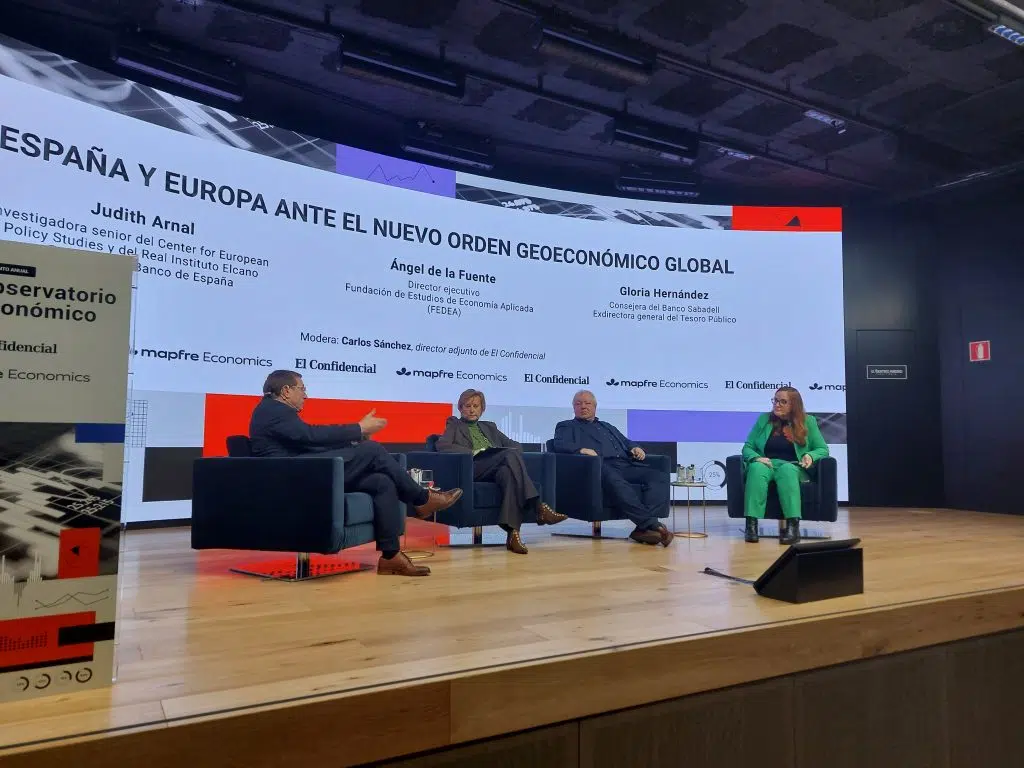
The second round focused on the position of Spain and Europe regarding the new global geoeconomic order, with the moderation of Carlos Sánchez, deputy director of El Confidencial. Gloria Hernández, director of Banco Sabadell and former director general of the Spanish Public Treasury, stated that one cannot speak of strategic autonomy in the European Union without financial integration, which includes a single Treasury and joint debt issues.
Judith Arnal, senior researcher at the Center for European Policy Studies and the Elcano Royal Institute, stated that Spain is in a good economic moment, but “we must not be complacent with the fiscal situation.” However, “the most worrying factor” is the situation in the U.S., which faces a fiscal sustainability problem—an “explosive” situation because its public debt is a core asset of the financial system. Arnal also emphasized that we have been seeing “growing economic divergences” between Europe and the U.S. for years, even before Trump.
Finally, Ángel de la Fuente, executive director of FEDEA, raised the need for a fiscal reform in Spain with consensus from the two major parties. The economist believes that “we need to rethink what mix of public services we want to provide, and how we finance them,” and pointed to the “opportunity cost” of maintaining the current pension system.