Mapfre RE, Mapfre’s reinsurance unit, ranks as the 12th largest reinsurer in the world based on premium volume (gross accepted), according to the Reinsurer Ranking prepared by Mapfre Economics, published for the first time this year, which ranks the 25 largest companies in the sector globally.
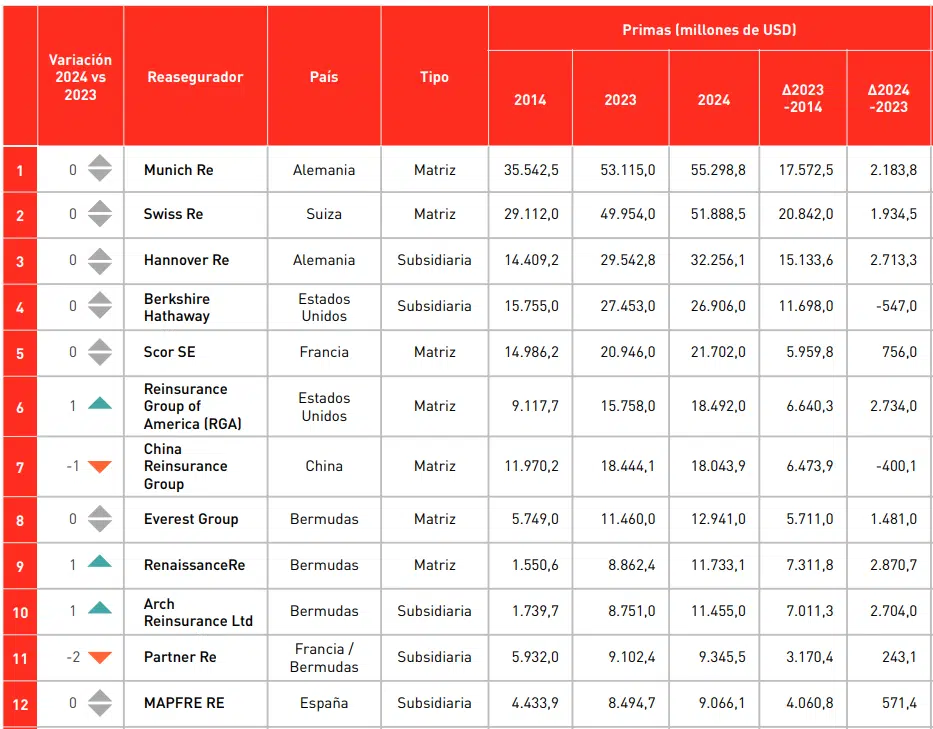
Mapfre RE places 12th “after a decade of sustained growth,” notes Mapfre Economics. The bulk of its business corresponds to Non-Life reinsurance, accounting for 8,493 million dollars, a segment in which it ranks in the top 10 of the world’s largest companies (10th place) with a 1.6% market share, compared to 1.1% in the overall ranking.
The ranking is topped by German firm Munich Re, with premiums of 39,410.6 million dollars; followed by Swiss Re, German firm Hannover Re, and the US firm Berkshire Hathaway. Closing out the top firms is Everest Group, based in Bermuda.
Industry trends
Mapfre Economic Research has estimated the total global reinsurance market volume coming in at 823,598 million dollars in 2024, 7.7% up on the previous year. The performance of the reinsurance business during the year has stabilized, following years of high volatility. Specifically, the increase in demand for insurance coverage has been driven by higher inflation, the increase in real insured values and the growth of the primary insurance business.
This year, Mapfre Economics expects that favorable conditions will continue, mainly thanks to the expansion in capacity, including capacity from alternative capital; sustained demand in Life and Damages; and opportunities in sectors such as energy, aviation, construction, and political risks.
As regards the breakdown of the total volume of reinsurance at a global level, 65% corresponds to Non-Life reinsurance, which includes catastrophic damage and property damage, and 35% to the Life segment. This distribution shows that there is a greater penetration of reinsurance in lines of business with high volatility or catastrophic exposure, in which the transfer of risk to reinsurance is more intensive. However, there are significant regional differences: while in America, Life reinsurance accounts for 49% of the total, in Europe and Africa as a whole it represents just 17%.
Both the Life business and the Non-Life business saw an increase of 7.7% last year. Mapfre Economics suggests that the Non-Life sector remained strong, especially in catastrophic coverage, while the expansion of the Life sector can be attributed to the increase in the transfer of risks related to longevity and savings.
Another of the structural trends that has been detected during the analysis by Mapfre Economics is the drop in market concentration. This phenomenon can be observed in the reduction in the share enjoyed by the ten largest reinsurance groups, which in 2014 came to 41.2% of the total business and in 2024, stood at 31.7%. This has also been the case in the Herfindahl index, which measures market concentration, which contracted by 49.2% during the period. All of this is indicative of strong competition and stakeholder diversity in the sector.
By region, America accounts for 57.1% of total gross premiums, Europe and Africa for 34.9%, and Asia and Oceania for 7.9%.
You can access the full report at this link.